


When your job leaves little time and energy for study, every preparation hour has to count. The RhMSUS exam question bank at PracticeVCE keeps sessions focused: 100+ Q&As with expert-verified answers, organized around the American College of Rheumatology Musculoskeletal Ultrasound Certification in Rheumatology objectives so nothing you read is wasted.
American College of Rheumatology RhMSUS Exam Syllabus Topics:
| Section | Objectives |
|---|---|
| Lower Extremity Ultrasound | - Knee, ankle, and foot evaluation - Hip joint assessment |
| Ultrasound-Guided Procedures | - Needle guidance and safety principles - Joint aspiration and injection techniques |
| Upper Extremity Ultrasound | - Shoulder joint evaluation - Elbow, wrist, and hand structures |
| Foundations of Musculoskeletal Ultrasound | - Image optimization and acquisition techniques - Ultrasound physics and instrumentation |
| Inflammatory and Degenerative Pathology | - Synovitis, effusions, and erosions - Tendinopathy and enthesitis patterns |
The American College of Rheumatology Musculoskeletal Ultrasound Certification in Rheumatology Exam: Practical Answers
Registration for the RhMSUS exam runs through these official channels:
Given the exam's cost, book your sitting when your mock-exam results — not your calendar — say you are ready.
Intended for licensed rheumatologists or rheumatology trainees with documented musculoskeletal ultrasound training and supervised clinical experience (specific eligibility requirements may vary by ACR cycle).
Same American College of Rheumatology Musculoskeletal Ultrasound Certification in Rheumatology content, different reach. The PC test engine runs on Windows, simulates the formal exam atmosphere, and shows you where your shortcomings and strengths lie — with no limit on the number of computers you install it on. The online test engine is available only at PracticeVCE: it runs on Windows, Mac, Android, and iOS, and once loaded it works without internet, so you can practice the RhMSUS exam questions on any device, at any time, anywhere. Both are built from the same daily-checked question bank.
The official outline divides the RhMSUS exam into weighted domains, including:
- Lower Extremity Ultrasound ()
- Inflammatory and Degenerative Pathology ()
- Ultrasound-Guided Procedures ()
The American College of Rheumatology Musculoskeletal Ultrasound Certification in Rheumatology practice questions at PracticeVCE follow these same objectives across all three formats — PDF, PC engine, and online engine.
Work with your constraints, not against them. Short, regular sessions beat rare marathon ones: run a timed mock early to map your shortcomings, then spend your limited hours on those weak areas using the expert-verified answers to close each gap. The RhMSUS exam bank is organized around the official objectives, so nothing you study is off-topic — and the online engine turns commutes and queues into usable American College of Rheumatology Musculoskeletal Ultrasound Certification in Rheumatology practice time.
American College of Rheumatology recommends these training resources for candidates:
If your schedule allows only one supplement to self-study, make it timed practice with verified answers — it converts knowledge into exam performance.
The RhMSUS exam is the official assessment behind the American College of Rheumatology Musculoskeletal Ultrasound Certification in Rheumatology certification from American College of Rheumatology. Many candidates come to it at a career plateau, looking for a credential that demonstrates verified, practical command of the published objectives. The exam rewards preparation — and preparation is the one part of the process fully under your control.
American College of Rheumatology Musculoskeletal Ultrasound Certification in Rheumatology Sample Questions:
In performing an in-plane ultrasound-guided procedure, it is helpful to orient the transducer so that the:
- A. Needle crosses the plane of the transducer.
- B. Transducer touches the point where the needle penetrates the skin.
- C. Target is as close as possible to the side of the transducer where the needle will be inserted.
- D. Needle angle relative to the transducer is minimized.
Correct Answer: C 🗳️
Which of the following images is MOST suggestive of sonographic features of patients with spondyloarthropathy?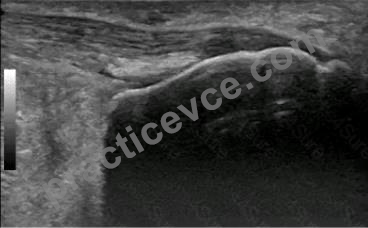
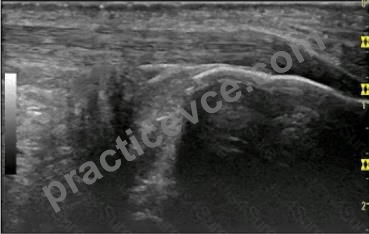
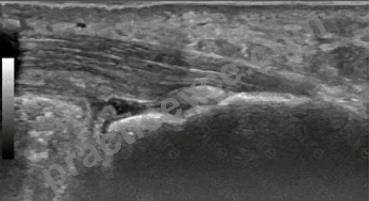
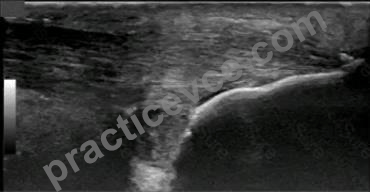
- A. Option D
- B. Option A
- C. Option C
- D. Option B
Correct Answer: C 🗳️
A 30-year-old female patient with rheumatoid arthritis reports pain at the medial malleolus. The medial side of the ankle is tender and seems to be swollen. How should a practitioner interpret the transverse images at the medial malleolus?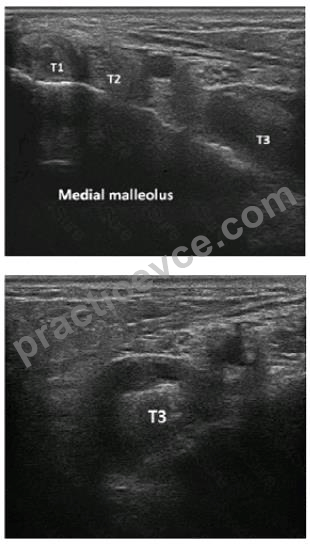
- A. Tenosynovitis of the flexor digitorum
- B. Tenosynovitis of the tibialis anterior tendon
- C. Tenosynovitis of the flexor hallucis longus
- D. Neurom of the tibiatis posterior nerve
Correct Answer: C 🗳️
Which of the following represents the BEST method for storing ultrasound images and relevant reports?
- A. Saved to the desktop in the exam room
- B. Saved to the ultrasound machine only
- C. Saved to a secure server with backup
- D. Saved to a secure personal flash drive
Correct Answer: C 🗳️
A 37-year-old female with a history of rheumatoid arthritis presents for sonographic evaluation. She has been in clinical remission for six months and is considering discontinuation of her biologic agent. Sonography of the right third metacarpophalangeal joint is shown. Which of the following is the MOST accurate description regarding this image?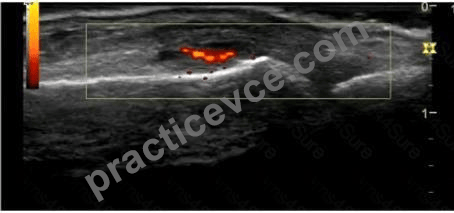
- A. Abnormal hypoechoic extra-articular tissue with Doppler signal
- B. Abnormal hyperechoic intra-articular tissue with Doppler signal
- C. Abnormal hyperechoic extra-articular tissue with Doppler signal
- D. Abnormal hypoechoic intra-articular tissue with Doppler signal
Correct Answer: D 🗳️
Viewing page 1 out of 20 pages.
Viewing questions 1-5 out of 100 questions.
 1394 Customer Reviews


