

Pass CyberArk CPC-CDE-RECERT Exam Quickly With PracticeVCE
Prepare CPC-CDE-RECERT Question Answers - CPC-CDE-RECERT Exam Dumps
NEW QUESTION # 18
Which component supports the required communication to send audit logs from Privilege Cloud through the Syslog protocol to a SIEM application?
- A. Privilege Cloud Connector
- B. CyberArk Identity Connector
- C. CyberArk Syslog Writer
- D. Secure Tunnel
Answer: D
Explanation:
CyberArk's Privilege Cloud documentation for SIEM integration (Syslog) states that to connect to SIEM in Privilege Cloud, you must first deploy the Secure Tunnel.
That means the Secure Tunnel is the required component that enables the communication path for sending Privilege Cloud audit logs via Syslog (TCP/TLS) to your SIEM.
Why the other options are not correct for this Privilege Cloud Syslog requirement:
* A (CyberArk Syslog Writer) is typically referenced in CyberArk Identity / ISP logging contexts, not as the required Privilege Cloud SIEM transport component. (Privilege Cloud SIEM doc calls out Secure Tunnel explicitly.)
* C (Privilege Cloud Connector) is not what the SIEM/Syslog doc identifies as the required prerequisite; it specifically calls out Secure Tunnel.
* D (CyberArk Identity Connector) is used to integrate directory services (AD/LDAP) with CyberArk Identity/Identity Administration, not as the Privilege Cloud Syslog transport prerequisite.
NEW QUESTION # 19
You are configuring an integration to provision users based on LDAP directory services for Privilege Cloud Shared Services. Which component must first be installed and configured in the environment to support this?
- A. Secure Tunnel
- B. CyberArk Identity Connector
- C. Linux Connector Server
- D. Privilege Cloud Connector
Answer: B
Explanation:
For Shared Services (ISPSS), CyberArk's Identity Administration documentation states: "To provision users based on on-prem directory services, you must first install the Identity Connector." This is because Privilege Cloud Shared Services leverages CyberArk Identity directory services integration (via the Identity Connector) for AD/LDAP provisioning and authentication.
NEW QUESTION # 20
What creating a new safe, what is the default number of password versions stored if using 'Save latest account versions' within version management settings?
- A. 0
- B. 1
- C. 2
- D. 3
Answer: A
Explanation:
CyberArk's Safe creation documentation explains that when you choose "Save the last <number> account versions" (also shown as "Save latest account versions" in some UIs), the Safe retains the most recent password versions indefinitely by keeping a fixed number of versions and rolling off the oldest. It also states that by default, the last five password versions are stored.
NEW QUESTION # 21
You are designing a CyberArk Privilege Cloud environment for a new customer with three data center locations: one in London, one in New York, and one in Singapore. The customer wants to reduce the amount of traffic on their dedicated network links between each data center. Which design should you consider to manage their credentials?
- A. Deploy three CPM connectors in New York, and configure region specific Safes to send traffic equally to each connector CPM.
- B. Deploy CPM connectors in each data center and configure region specific Safes.
- C. Deploy CPM connectors in a single data center because the password management traffic is routed through the Privilege Cloud service.
- D. Deploy a CPM connector in London and increase the number of days between password changes.
Answer: B
Explanation:
CyberArk recommends placing connector host machines geographically as close as possible to their targets to reduce latency and (practically) minimize WAN traffic between sites.
Since CPM password rotations/verifications occur between the CPM component and the target systems in the customer network, deploying CPM connectors in each data center (near those local targets) and organizing/segregating by region (for example via region-specific Safes/target scoping) is the design that best reduces cross-data-center traffic.
NEW QUESTION # 22
When installing the first CPM within Privilege Cloud using the Connector Management Agent, what should you set the Installation Mode to in the CPM section?
- A. Default
- B. Primary
- C. Passive
- D. Active
Answer: D
Explanation:
When installing the first CyberArk Privilege Management (CPM) instance in the Privilege Cloud using the Connector Management Agent, the installation mode should be set to "Active". This configuration sets the CPM to be actively involved in password management and task processing without being in a standby or passive mode. Here are the step-by-step details:
* Download the Connector Management Agent: Obtain the installer from the CyberArk Marketplace or your installation kit.
* Run the Installer: Start the setup and select the CPM component to install.
* Choose Installation Mode: When prompted, select "Active" as the installation mode. This sets up the CPM as the primary node responsible for handling password management operations.
This setup ensures that the CPM is immediately active and capable of handling requests without waiting for manual intervention or failover.
Reference: CyberArk's official documentation provides guidance on setting up the CPM, where it specifies the modes and their purposes.
NEW QUESTION # 23
After correctly configuring reconciliation parameters in the Prod-AIX-Root-Accounts Platform, this error message appears in the CPM log: CACPM410E Ending password policy Prod-AIX-Root-Accounts since the reconciliation task is active but the AllowedSafes parameter was not updated What caused this situation?
- A. A second CPM is incorrectly configured to manage the reconciliation account's safe which is causing a deadlock situation between the two CPMs.
- B. The AllowedSafes parameter does not include the safe containing the reconciliation account defined in the Platform.
- C. The CPM is currently configured to use to an unsigned engine.
- D. The reconciliation account defined in the Platform is in a locked state and is not accessible.
Answer: B
Explanation:
The error message "CACPM410E Ending password policy Prod-AIX-Root-Accounts since the reconciliation task is active but the AllowedSafes parameter was not updated" suggests an issue with configuration parameters. The likely cause is:
* The AllowedSafes parameter does not include the safe containing the reconciliation account defined in the Platform (Option C). This parameter must accurately reflect all safes where the reconciliation account operates to ensure proper management and access by the Central Policy Manager (CPM). If the safe containing the reconciliation account is not listed, the CPM cannot perform its tasks, leading to this error.
Reference: CyberArk's error codes and troubleshooting guides detail how specific configuration mismatches, like an incomplete AllowedSafes parameter, can disrupt normal operations, especially in reconciliation processes.
NEW QUESTION # 24
Arrange the steps to failover to the passive CPM in the correct sequence.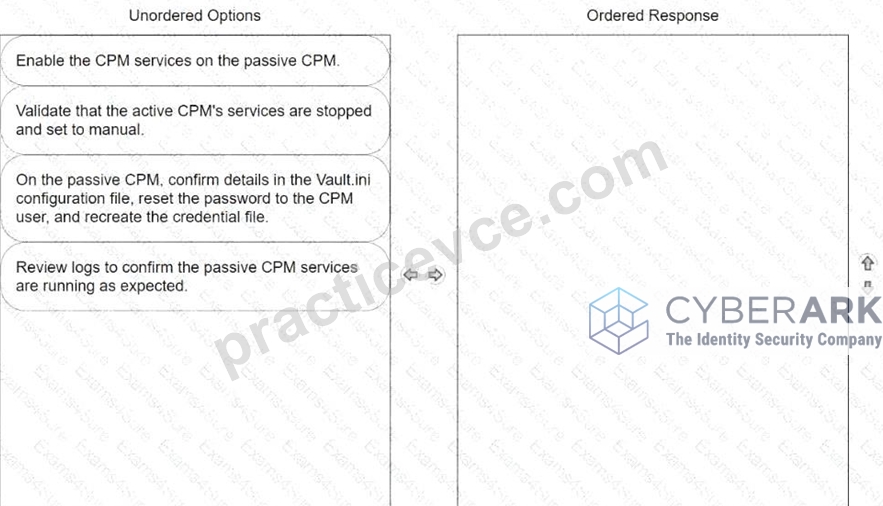
Answer:
Explanation: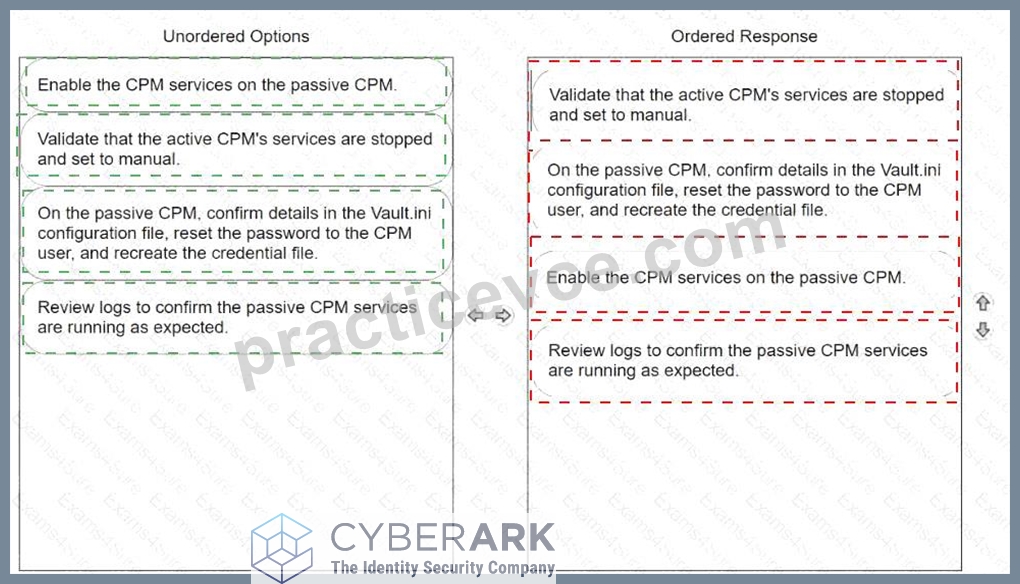
Explanation:
To properly arrange the steps for failing over to a passive Central Policy Manager (CPM) in CyberArk, the sequence should be as follows:
* Validate that the active CPM's services are stopped and set to manual.Before enabling the passive CPM, ensure that the services on the active CPM are stopped. This prevents any conflicts or data corruption by making sure that only one CPM is active at a time. Setting the services to manual ensures they do not restart automatically, which is crucial during a failover scenario.
* On the passive CPM, confirm details in the Vault.ini configuration file, reset the password to the CPM user, and recreate the credential file.This step involves making sure the passive CPM has the correct configuration to seamlessly take over operations. Adjustments in the Vault.ini file may be necessary to ensure it is pointing to the correct Vault and network settings. Resetting the password and recreating the credential file are critical to secure the login and authentication process for the newly active CPM.
* Enable the CPM services on the passive CPM.Once the passive CPM is correctly configured and ready, enable its services to begin handling the tasks and responsibilities of the primary CPM. This action effectively switches the role from passive to active, enabling the passive CPM to function as the new operational manager.
* Review logs to confirm the passive CPM services are running as expected.Finally, review the system and application logs to confirm that the now-active CPM is operating correctly and that all services have started without errors. This step is vital for verifying that the failover process was successful and that the system is stable.
Following this ordered sequence ensures a smooth transition of roles from the active CPM to the passive CPM, minimizing downtime and potential disruptions in the privileged access management operations.
NEW QUESTION # 25
Which authentication methods does PSM for SSH support? (Choose 2.)
- A. OIDC
- B. MFA Caching
- C. RADIUS
- D. SAML
- E. Client Authentication Certificate
Answer: C,E
Explanation:
PSM for SSH supports various authentication methods, specifically focusing on secure and verified access mechanisms. The supported methods include:
* RADIUS (D): Remote Authentication Dial-In User Service (RADIUS) is a networking protocol that provides centralized Authentication, Authorization, and Accounting management for users who connect and use a network service. PSM for SSH utilizes RADIUS to authenticate SSH sessions, which adds an additional layer of security by centralizing authentication requests to a RADIUS server.
* Client Authentication Certificate (E): This method uses certificates for authentication, where a client presents a certificate that the server verifies against known trusted certificates. This type of authentication is highly secure as it ensures that both parties involved in the communication are precisely who they claim to be, making it suitable for environments that require stringent security measures.
These methods provide robust security options for SSH sessions managed through CyberArk's PSM, ensuring that only authorized users can access critical systems.
NEW QUESTION # 26
Which statements are correct regarding enabling end users from multiple domains in the same forest to authenticate to CyberArk Privilege Cloud? (Choose two.)
- A. Configuring authentication for users in multiple domains in the same forest is not recommended due to potential performance issues.
- B. To enable authentication for users in multiple domains in the same forest, you should install separate CyberArk Identity Connectors for each independent domain.
- C. CyberArk recommends consolidating users from multiple domains in the same forest into the CyberArk Cloud Directory for this specific use case.
- D. This can be accomplished when the users' Active Directory accounts are in domains with domain controllers that have a two-way, transitive trust relationship with the domain controller to which the connector is connected.
- E. CyberArk does not permit end users from multiple domains to authenticate to CyberArk Privilege Cloud; it only allows users from multiple directory services, such as AD, Azure AD, CyberArk Cloud Directory, etc.
Answer: B,D
Explanation:
CyberArk's official connector guidance (CyberArk Identity / Identity Administration-used with Privilege Cloud Shared Services for AD user authentication) says that for trusted domains in a single forest, you use this model when the domain controllers have a two-way, transitive trust relationship with the domain controller the connector is joined to.
It also clarifies that a single connector can be used for the entire domain tree or forest in that trusted- domain model, and authentication requests are handled according to AD trust relationships within the forest
/tree.
https://docs.cyberark.com/identity/latest/en/content/coreservices/connector/userauthmultdomain.htm
NEW QUESTION # 27
What is the navigation path to add account search properties?
- A. Go to Policies > Master Policy
- B. Go to Administration > Configuration Options > Applications > Search Properties
- C. Go to Administration > Configuration Options > Configurations > Search Properties
- D. Go to Administration > Configuration Options > Configurations > Accounts UI Preferences > Main > Toolbar actions
Answer: C
Explanation:
CyberArk's Privilege Cloud procedure for adding account search properties states:
* In the Privilege Cloud Portal, go to Administration > Configuration Options
* Under Configurations, right-click Search Properties # Add Property
That is option B.
NEW QUESTION # 28
Which Safe(s) does the AllowedSafes=Win platform parameter configuration match? (Choose two.)
- A. SQL-Win-SA
- B. WiNdOwS_Accts
- C. CXD-WIN-ADMINS
- D. win-ssh-keys
- E. WindowsPasswords
Answer: A,E
Explanation:
AllowedSafes is a regular expression and is case sensitive.
The regex Win (with no anchors) will match any Safe name that contains the exact substring "Win" with the same case:
* WindowsPasswords # starts with Win #
* SQL-Win-SA # contains Win #
* win-ssh-keys # contains win (lowercase) # (case sensitive)
* CXD-WIN-ADMINS # contains WIN (all caps) #
* WiNdOwS_Accts # mixed case, does not contain the exact substring Win # Therefore the correct choices are A and D.
NEW QUESTION # 29
Which option correctly describes the authentication differences between CyberArk Privilege Cloud and CyberArk PAM Self-Hosted?
- A. CyberArk Privilege Cloud only provides a username and password authentication without third-party IdP integration; CyberArk PAM Self-Hosted uses traditional on-premises methods such as Windows and LDAP. but lacks modern protocols such as SAML or OIDC.
- B. CyberArk Privilege Cloud requires on-premises components for all authentication and does not support other cloud-based authentication protocols; CyberArk PAM Self-Hosted offers a wide array of methods, including support for SAML. OIDC. and other modern protocols, without needing on- premises components.
- C. Both use the same authentication methods.
- D. CyberArk Privilege Cloud uses cloud-based methods, integrating with CyberArk Identity for MFA. and supports SAML and OIDC; CyberArk PAM Self-Hosted depends on on-premises methods such as RADIUS and LDAP, but can adopt SAML or OIDC with additional setups.
Answer: D
Explanation:
The correct description of the authentication differences between CyberArk Privilege Cloud and CyberArk PAM Self-Hosted is that CyberArk Privilege Cloud uses cloud-based methods, integrating with CyberArk Identity for Multi-Factor Authentication (MFA), and supports SAML and OIDC, while CyberArk PAM Self- Hosted relies on on-premises methods such as RADIUS and LDAP, but can adopt SAML or OIDC with additional setups. CyberArk Privilege Cloud is designed to leverage modern cloud-based authentication protocols to enhance security and ease of use, particularly in distributed and diverse IT environments. In contrast, CyberArk PAM Self-Hosted offers flexibility to use traditional on-premises authentication methods but also supports modern protocols if configured to do so.
NEW QUESTION # 30
Refer to the exhibit.
You set up your LDAP Directory in CyberArk Identity, but encountered an error during the connection test.
Which scenarios could represent a valid misconfiguration? (Choose 2.)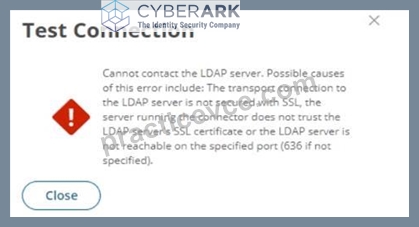
- A. Verify Server Certificate' is activated but the provided hostname is not listed as a Subject Alternative Name (SAN) in the LDAP server's certificate.
- B. TCP Port 636 could be blocked by a network firewall, preventing communication between the CyberArk Identity Connector and the LDAP Server.
- C. TCP Port 636 could be blocked by a network firewall, preventing communication between the Secure Tunnel and the LDAP Server.
- D. All required CA Certificates have been installed on the CyberArk Identity Connector but the LDAP Bind credentials provided are incorrect.
Answer: A,B
Explanation:
From the error message provided, two likely scenarios could represent valid misconfigurations:
* TCP Port 636 could be blocked by a network firewall, preventing communication between the CyberArk Identity Connector and the LDAP Server (A). This is a common issue where firewall settings prevent the secure communication port (typically 636 for LDAPS) from transmitting data between the server and the connector, thus blocking the connection attempt.
* 'Verify Server Certificate' is activated but the provided hostname is not listed as a Subject Alternative Name (SAN) in the LDAP server's certificate (C). This scenario occurs when SSL/TLS security measures are stringent, requiring that the hostname used to connect to the LDAP server must match one listed in the server's SSL certificate. If the hostname does not match, the connection will fail due to SSL certificate validation errors.
NEW QUESTION # 31
You have been tasked with deploying a Privilege Cloud PSM for SSH connector When the initial installation has successfully completed, you create and permission several maintenance users to be used for administering the connector.
Which configuration file must be updated to define these maintenance users?
- A. sshd_config
- B. psmpparms
- C. basic_psmpserver.conf
- D. sshd.config
Answer: A
Explanation:
The sshd_config file is the correct configuration file that must be updated to define maintenance users for administering the Privilege Cloud PSM for SSH connector. This file contains configurations for the SSH daemon, including user permissions and group settings. When adding maintenance users, their user accounts are created on the PSM server, and then they are added to the AllowGroups parameter within the sshd_config file to grant them the necessary permissions.
:
CyberArk documentation on the PSM for SSH environment1.
CyberArk Sentry guide on how to add maintenance users for SSH PSM
When deploying a Privilege Cloud PSM for SSH connector, the configuration file that must be updated to define maintenance users is "sshd_config". This file is used to configure options specific to the SSH daemon, which includes user permissions, authentication methods, and other security-related settings. To add and configure maintenance users for the PSM for SSH, you will need to modify this file to specify allowed users and their respective privileges.
Reference: The configuration of SSH-related components typically involves the "sshd_config" file, as outlined in SSH and PSM for SSH setup guides. This is a standard practice in systems that utilize SSH for secure communications and management.
NEW QUESTION # 32
When creating a new Safe, if you select "Save account versions for a period of days" within Version Retention settings, what is the default number of days that password versions are saved?
- A. 0
- B. 1
- C. 2
- D. 3
Answer: D
Explanation:
In Privilege Cloud, each Safe controls its own retention policy for account/password objects. CyberArk documentation states that when retention is set by Number of days, the default retention is 7 days.
NEW QUESTION # 33
Before you can delete a Safe, you must first delete all of its content (accounts and files) permanently. What else must also be achieved before the Safe can be successfully deleted?
- A. The associated CPM user has been removed from the Safe.
- B. The version retention period has expired for all files.
- C. The Safe owners have been removed from the Safe membership.
- D. The "Save account versions for a period of:" has been set to 0 within the Safe version retention settings.
Answer: B
Explanation:
CyberArk states that a Safe can be deleted only after its contents are deleted permanently, and (critically) objects are only deleted permanently after their retention/versions retention has passed. In the Privilege Cloud Safe management documentation, it notes that accounts are deleted permanently only after their retention period has passed, which is why deletion can be blocked by "non-expired" objects.
The underlying Vault/PACLI behavior is also explicit: "It is only possible to delete a Safe after the version retention period has expired for all files contained in the Safe." So, beyond deleting the content, the version retention period must have expired for all files # B.
NEW QUESTION # 34
What is the recommended method to enable load balancing and failover of the CyberArk Identity Connector?
- A. Set up a network load balancer between two or more CyberArk Identity Connector servers.
- B. Set up two or more CyberArk Identity Connector servers only.
- C. Set up a Microsoft Failover Cluster on two or more CyberArk Identity Connector servers.
- D. Setup IIS based Application Request Routing on two or more CyberArk Identity Connector servers.
Answer: B
Explanation:
https://docs.cyberark.com/identity/latest/en/content/coreservices/connector/connector-install.htm
NEW QUESTION # 35
How should you configure PSM for SSH to support load balancing?
- A. by using a network load balancer
- B. by editing sshd.config on the all the PSM for SSH servers
- C. in PVWA > Options > PSM for SSH Proxy > Servers > VIP
- D. in PVWA > Options > PSM for SSH Proxy > Servers
Answer: C
NEW QUESTION # 36
When installing PSM on a Windows 2019 Server, under which circumstances should the PSMConnect and PSMAdminConnect users be moved to the domain? (Choose two.)
- A. When you want to extend PSM sessions beyond one hour
- B. When you need to enable PSM for Web Support
- C. When the RDS session broker has a value > 1
- D. When you want to load balance the PSM installation
- E. When RDS CAL Per User licenses are in use
Answer: A,E
Explanation:
CyberArk explicitly states that you must move PSM application users (PSMConnect/PSMAdminConnect) to domain users on Windows 2019/2022 when:
* you are using RDS CAL per-user licensing, and
* you want to extend PSM sessions beyond one hour.
NEW QUESTION # 37
Arrange the steps to install passive CPM using Connector Management in the correct sequence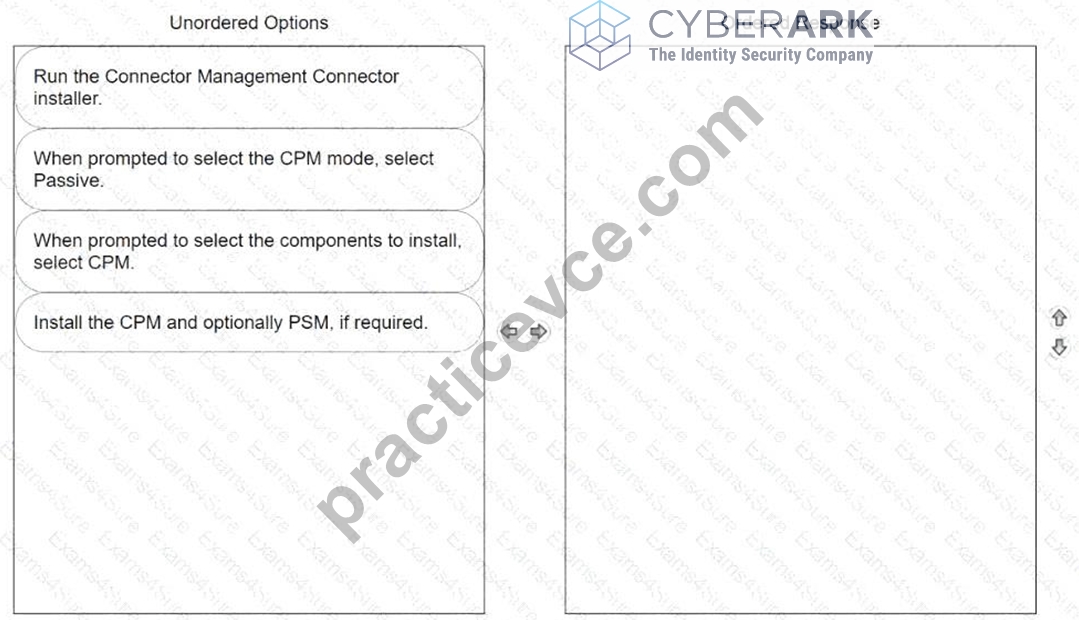
Answer:
Explanation: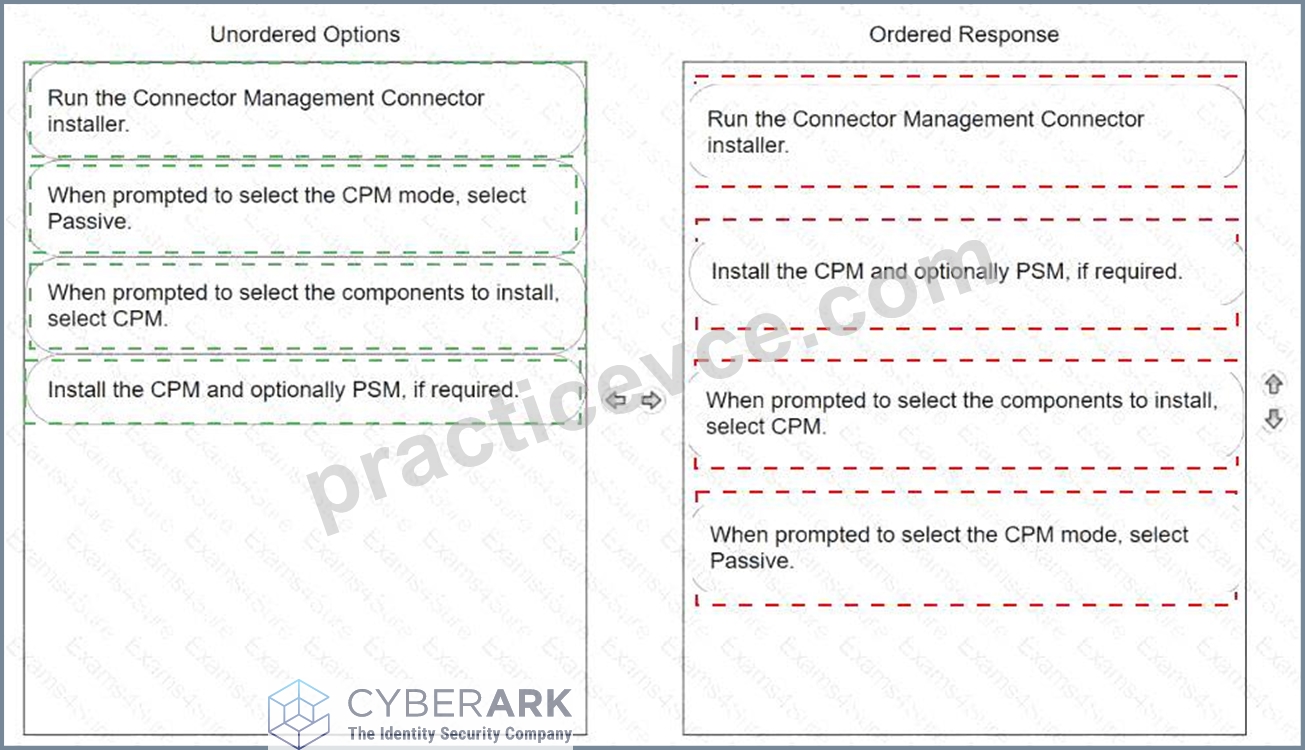
Explanation:
1-Run the Connector Management Connector installer
2-Install the CPM and PSM
3-When you are prompted to select the components to install, select CPM.
4-When you are prompted to select the CPM mode, select Passive.
https://docs.cyberark.com/ispss-deployment/latest/en/content/privilege%20cloud/privcloud-cpm-dr-install- config.htm
NEW QUESTION # 38
When installing the PSM and CPM components on the same Privilege Cloud Connector, what should you consider when hardening?
- A. CPM settings override the PSM settings when referring to the same parameter
- B. They can only be installed on the same Privilege Cloud Connector when installed 'in Domain'.
- C. PSM settings override the CPM settings when referring to the same parameter.
- D. They can only be installed on the same Privilege Cloud Connector when installed 'out of Domain'.
Answer: C
Explanation:
When installing the PSM and CPM components on the same Privilege Cloud Connector and considering the hardening process, it's important to note that PSM settings override the CPM settings when referring to the same parameter. This hierarchy is crucial in ensuring that the more stringent security settings required by PSM, which typically handles direct interaction with end-user sessions, take precedence over CPM settings.
This setup helps maintain robust security practices by applying the most restrictive configuration where conflicts occur.
NEW QUESTION # 39
Which method can be used to directly authenticate users to PSM for SSH? (Choose three.)
- A. OpenID Connect (OIDC) authentication
- B. Windows authentication
- C. LDAP authentication
- D. CyberArk authentication
- E. RADIUS authentication
- F. SAML authentication
Answer: C,D,E
Explanation:
CyberArk states that users can authenticate to the Vault through PSM for SSH using:
* CyberArk password authentication (i.e., CyberArk authentication),
* LDAP, and
* RADIUS (including challenge-response).
Windows, SAML, and OIDC are not listed as direct PSM for SSH authentication methods in the PSM for SSH authentication configuration (Privilege Cloud / PSM for SSH uses the configured PSM for SSH authentication methods such as Password/LDAP/RADIUS)
NEW QUESTION # 40
......
Real CyberArk CPC-CDE-RECERT Exam Questions [Updated 2026]: https://vceplus.practicevce.com/CyberArk/CPC-CDE-RECERT-practice-exam-dumps.html