

2022 Free Microsoft AZ-400 Exam Files Downloaded Instantly
Pass Microsoft AZ-400 exam Dumps 100 Pass Guarantee With Latest Demo
NEW QUESTION 179
You are configuring the Azure DevOps dashboard. The solution must meet the technical requirements.
Which widget should you use for each metric? To answer, drag the appropriate widgets to the correct metrics. Each widget may be used once, more than once, or not at all. You may need to drag the split bar between panes or scroll to view content.
NOTE: Each correct selection is worth one point.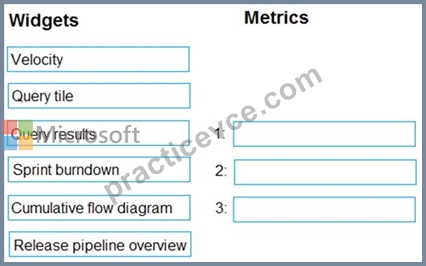
Answer:
Explanation: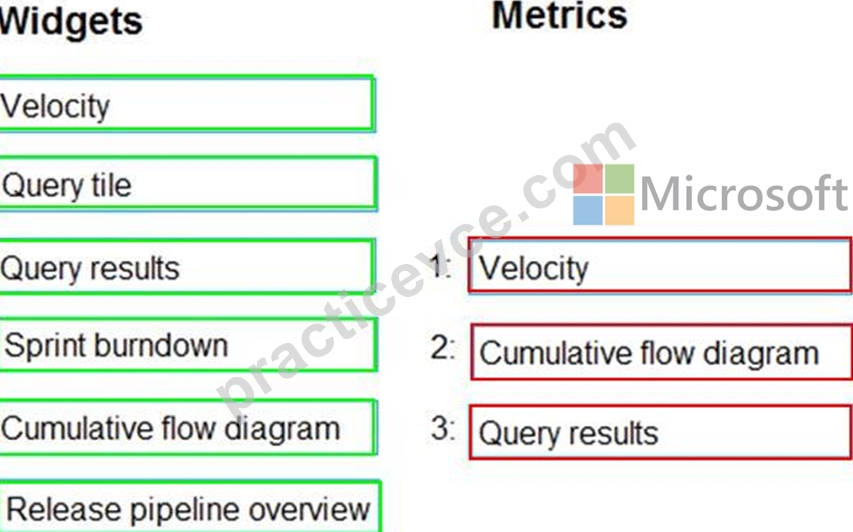
Reference:
https://docs.microsoft.com/en-us/azure/devops/report/dashboards/widget-catalog?view=azure-devops
NEW QUESTION 180
You need to configure access to Azure DevOps Agent pools to meet the forwarding requirements:
* Use a project agent pool when authoring build release pipelines.
* View the agent pool and agents of the organization.
* Use the principle of least privilege.
Which role memberships are required for the Azure 0e%Oos organization and the project? To answer, drag the appropriate role membership to the correct targets. Each role membership may be used once, more than once, or not at all. You may need to drag the split bar between panes or scroll to content NOTE: Each correct selection is worth one point.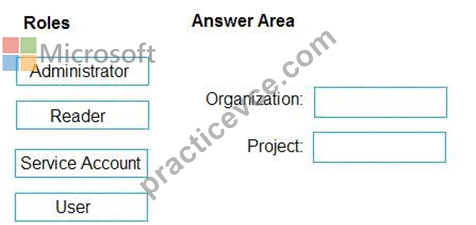
Answer:
Explanation: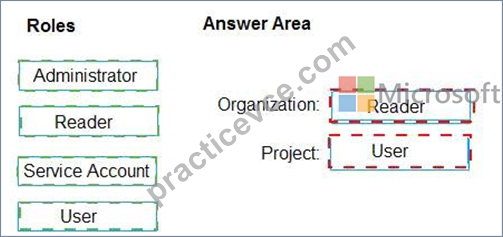
Explanation
project level role: UserOrganization level role: Reader
References: https://docs.microsoft.com/en-us/azure/devops/pipelines/agents/pools-queues
NEW QUESTION 181
You have an Azure DevOps project named Project1 and an Azure subscription named Sub1.
You need to prevent releases from being deployed unless the releases comply with the Azure Policy rules assigned to Sub1.
What should you do in the release pipeline of Project1?
- A. Create a pipeline variable.
- B. Add a deployment gate.
- C. Configure a deployment trigger.
- D. Modify the Deployment queue settings.
Answer: B
NEW QUESTION 182
You are deploying a new application that uses Azure virtual machines.
You plan to use the Desired State Configuration (DSC) extension on the virtual machines.
You need to ensure that the virtual machines always have the same Windows features installed.
Which three actions should you perform in sequence? To answer, move the appropriate actions from the list of actions to the answer area and arrange them in the correct order.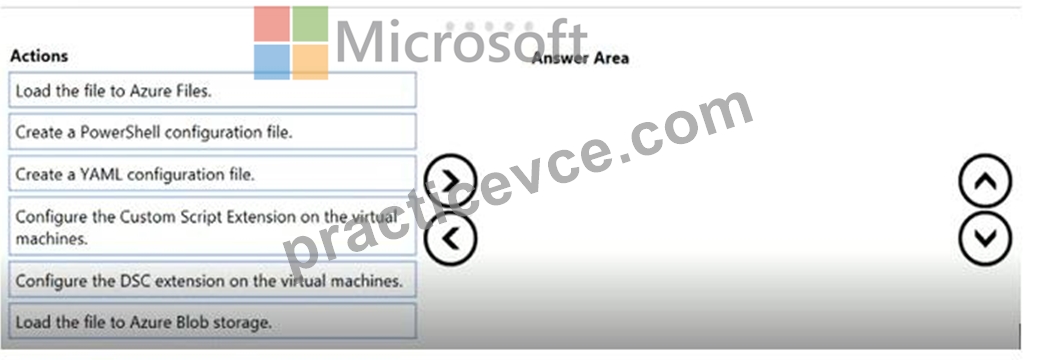
Answer:
Explanation: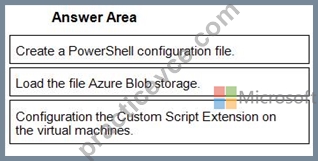
1 - Create a PowerShell configuration file.
2 - Load the file Azure Blob storage.
3 - Configuration the Custom Script Extension on the virtual machines.
Explanation:
Step 1: Create a PowerShell configuration file
You create a simple PowerShell DSC configuration file.
Step 2: Load the file to Azure Blob storage
Package and publish the module to a publically accessible blob container URL
Step 3: Configure the Custom Script Extension on the virtual machines.
The Custom Script Extension downloads and executes scripts on Azure virtual machines.
Reference:
https://docs.microsoft.com/en-us/azure/automation/automation-dsc-getting-started
https://docs.microsoft.com/en-us/azure/virtual-machines/extensions/custom-script-windows
NEW QUESTION 183
Note: This question is part of a series of questions that present the same scenario. Each question in the series contains a unique solution that might meet the stated goals. Some question sets might have more than one correct solution, while others might not have a correct solution.
After you answer a question in this section, you will NOT be able to return to it. As a result, these questions will not appear in the review screen.
Your company has a project in Azure DevOps for a new web application.
You need to ensure that when code is checked in, a build runs automatically.
Solution: From the Triggers tab of the build pipeline, you select Enable continuous integration.
Does this meet the goal?
- A. No
- B. Yes
Answer: A
Explanation:
Explanation/Reference:
Explanation:
In Visual Designer you enable continuous integration (CI) by:
1. Select the Triggers tab.
2. Enable Continuous integration.
A continuous integration trigger on a build pipeline indicates that the system should automatically queue a new build whenever a code change is committed.
References:
https://docs.microsoft.com/en-us/azure/devops/pipelines/get-started-designer
NEW QUESTION 184
You have a web app hosted on Azure App Service. The web app stores data in an Azure SQL database.
You need to generate an alert when there are 10,000 simultaneous connections to the database. The solution must minimize deve4opment effort.
Which option should you select in the Diagnostics settings of the database?
- A. Archive to m storage account
- B. Stream to an event hub
- C. Send to Log Analytics
Answer: C
Explanation:
ENABLE DIAGNOSTICS TO LOG ANALYTICS
This configuration is done PER DATABASE
1. Click on Diagnostics Settings and then Turn On Diagnostics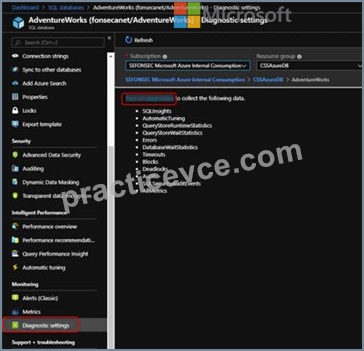
2. Select to Send to Log Analytics and select the Log Analytics workspace. For this sample I will selected only Errors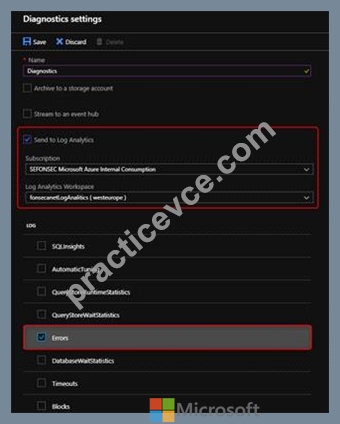
Reference:
https://techcommunity.microsoft.com/t5/azure-database-support-blog/azure-sql-db-and-log-analytics-better-together-part-1/ba-p/794833
NEW QUESTION 185
You need to implement Project6.
Which three actions should you perform in sequence? To answer, move the appropriate actions from the list of actions to the answer area and arrange them m the correct order.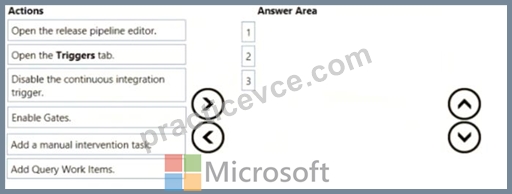
Answer:
Explanation: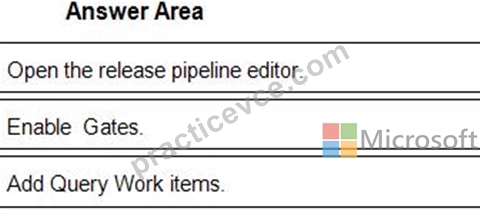
1 - Open the release pipeline editor.
2 - Enable Gates.
3 - Add Query Work items.
Reference:
https://docs.microsoft.com/en-us/azure/devops/pipelines/release/deploy-using-approvals?view=azure-devops#configure-gate
NEW QUESTION 186
You are implementing an Azure DevOps strategy for mobile devices using App Center.
You plan to use distribution groups to control access to releases.
You need to create the distribution groups shown in the following table.
Which type of distribution group should you use for each group? To answer, drag the appropriate group types to the correct locations. Each group type may be used once, more than once, or not at all. You may need to drag the split bar between panes or scroll to view content.
NOTE: Each correct selection is worth one point.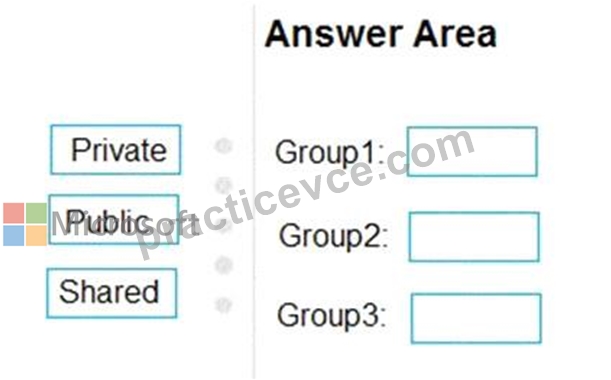
Answer:
Explanation: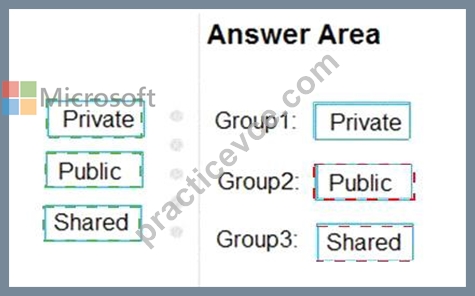
Explanation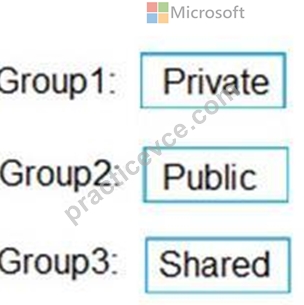
Box1: Private
In App Center, distribution groups are private by default. Only testers invited via email can access the releases available to this group.
Box 2: Public
Distribution groups must be public to enable unauthenticated installs from public links.
Box 3: Shared
Shared distribution groups are private or public distribution groups that are shared across multiple apps in a single organization.
Reference:
https://docs.microsoft.com/en-us/appcenter/distribution/groups
NEW QUESTION 187
You have multi-tier application that he an Azure Web Apps front end and art Azure SQL Datable back end.
You need to recommend a solution to capture and store telemetry data. The solution must meet the following requirements:
* Support using ad-hoc queries to identify baselines.
* Trigger alerts when metrics in the baseline are exceeded.
* Store application and database metrics in a central location.
What should you include in the recommendation?
- A. Azure SQL Database Intelligent Insights
- B. Azure Log Analytics
- C. Azure Event Hubs
- D. Azure Application Insights
Answer: B
Explanation:
Azure Platform as a Service (PaaS) resources, like Azure SQL and Web Sites (Web Apps), can emit performance metrics data natively to Log Analytics.
The Premium plan will retain up to 12 months of data, giving you an excellent baseline ability.
There are two options available in the Azure portal for analyzing data stored in Log analytics and for creating queries for ad hoc analysis.
References:
https://docs.microsoft.com/en-us/azure/azure-monitor/platform/collect-azurepass-posh
NEW QUESTION 188
You have a project in Azure DevOps. You have an Azure Resource Group deployment project in Microsoft
Visual Studio that is checked in to the Azure DevOps project.
You need to create a release pipeline that will deploy resources by using Azure Resource Manager templates.
The solution must minimize administrative effort.
Which task type should you include in the solution?
- A. Azure App Service Manage
- B. Azure Cloud Service Deployment
- C. Azure PowerShell
- D. Azure RM Web App Deployment
Answer: C
Explanation:
There are two different ways to deploy templates to Azure DevOps Services. Both methods provide the same
results, so choose the one that best fits your workflow.
1. Add a single step to your build pipeline that runs the PowerShell script that's included in the Azure
Resource Group deployment project (Deploy-AzureResourceGroup.ps1). The script copies artifacts and
then deploys the template.
2. Add multiple Azure DevOps Services build steps, each one performing a stage task.
The first option has the advantage of using the same script used by developers in Visual Studio and providing
consistency throughout the lifecycle.
References:
https://docs.microsoft.com/en-us/azure/vs-azure-tools-resource-groups-ci-in-vsts
NEW QUESTION 189
Your team uses an agile development approach.
You need to recommend a branching strategy for the team's Git repository. The strategy must meet the following requirements.
Provide the ability to work on multiple independent tasks in parallel.
Ensure that checked-in code remains in a releasable state always.
Ensure that new features can be abandoned at any time.
Encourage experimentation.
What should you recommend?
- A. a single long-running branch
- B. a single fork per team member
- C. a single-running branch with multiple short-lived topic branches
- D. multiple long-running branches
Answer: C
Explanation:
Explanation
Topic branches, however, are useful in projects of any size.
A topic branch is a short-lived branch that you create and use for a single particular feature or related work.
This is something you've likely never done with a VCS before because it's generally too expensive to create and merge branches. But in Git it's common to create, work on, merge, and delete branches several times a day.
Reference:
https://git-scm.com/book/en/v2/Git-Branching-Branching-Workflows
NEW QUESTION 190
Your company has an Azure subscription named Subscription1. Subscription1 is associated to an Azure Active Directory tenant named contoso.com.
You need to provision an Azure Kubernetes Services (AKS) cluster in Subscription1 and set the permissions for the cluster by using RBAC roles that reference the identities in contoso.com.
Which three objects should you create in sequence? To answer, move the appropriate objects from the list of objects to the answer area and arrange them in the correct order.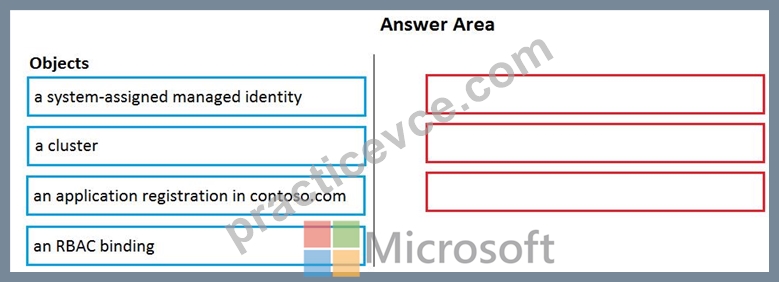
Answer:
Explanation: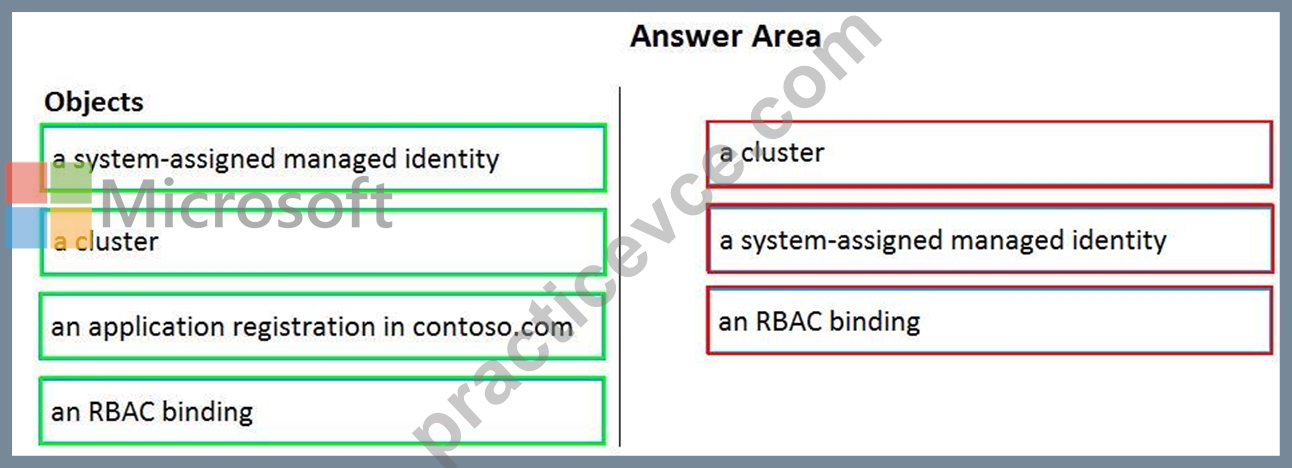
Explanation:
Step 1: Create an AKS cluster
Step 2: a system-assigned managed identity
To create an RBAC binding, you first need to get the Azure AD Object ID.
* Sign in to the Azure portal.
* In the search field at the top of the page, enter Azure Active Directory.
* Click Enter.
* In the Manage menu, select Users.
* In the name field, search for your account.
* In the Name column, select the link to your account.
* In the Identity section, copy the Object ID.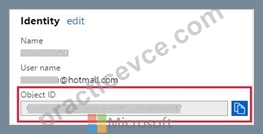
Step 3: a RBAC binding
Reference:
https://docs.microsoft.com/en-us/azure/developer/ansible/aks-configure-rbac
NEW QUESTION 191
You have an application named App1 that has a custom domain of app.contoso.com.
You create a test in Azure Application Insights as shown in the following exhibit.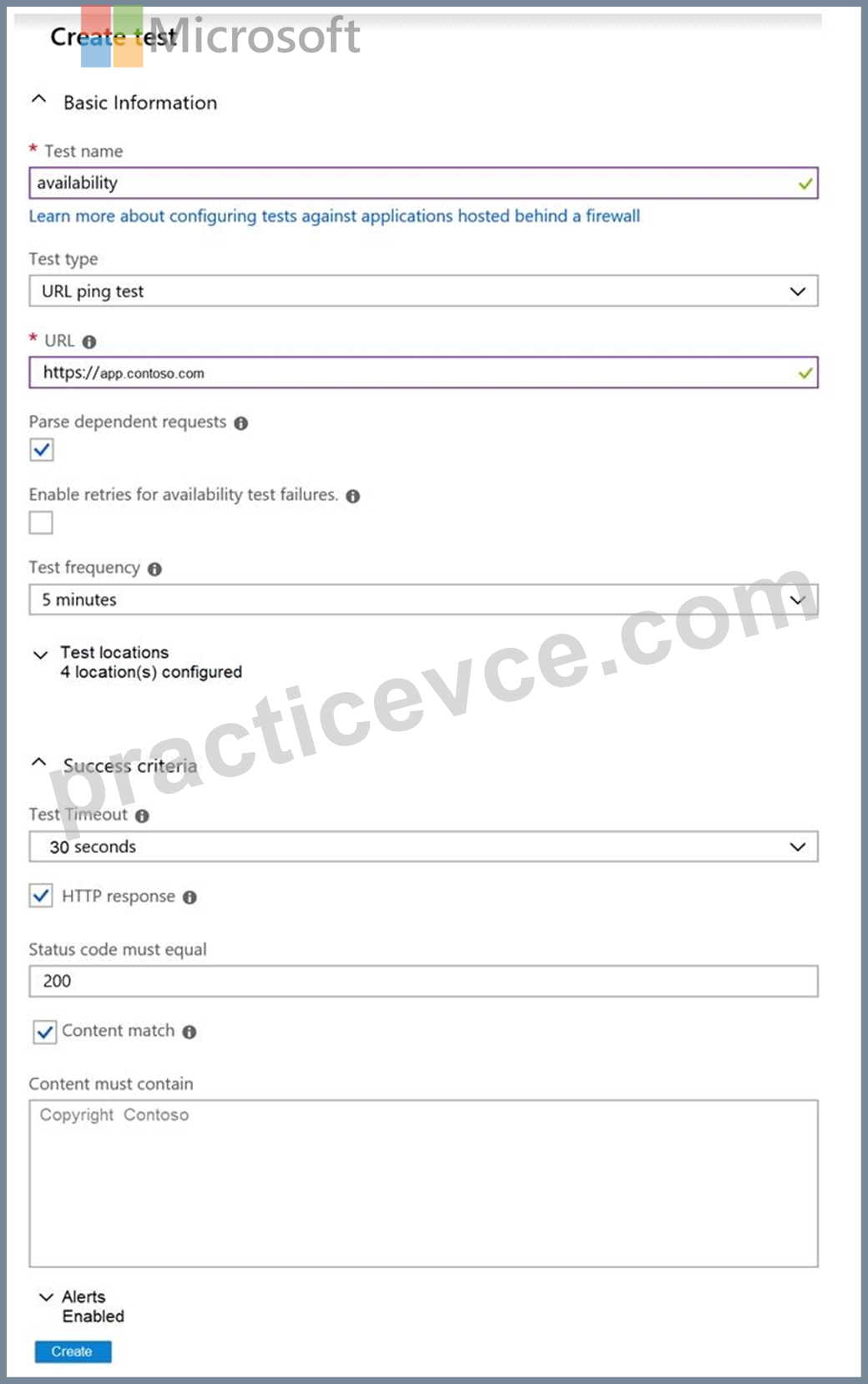
Use the drop-down menus to select the answer choice that completes each statement based on the information presented in the graphic.
NOTE: Each correct selection is worth one point.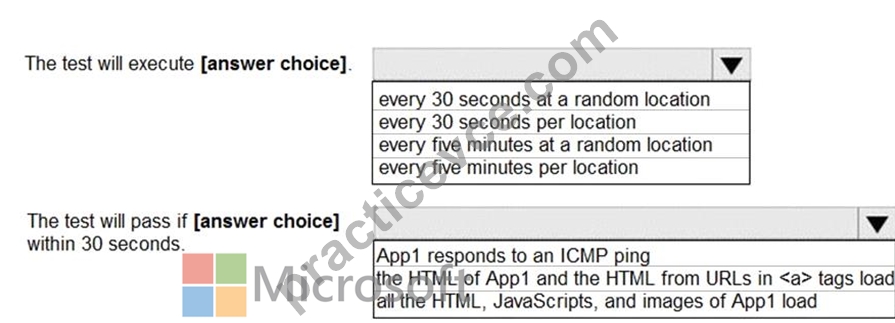
Answer:
Explanation: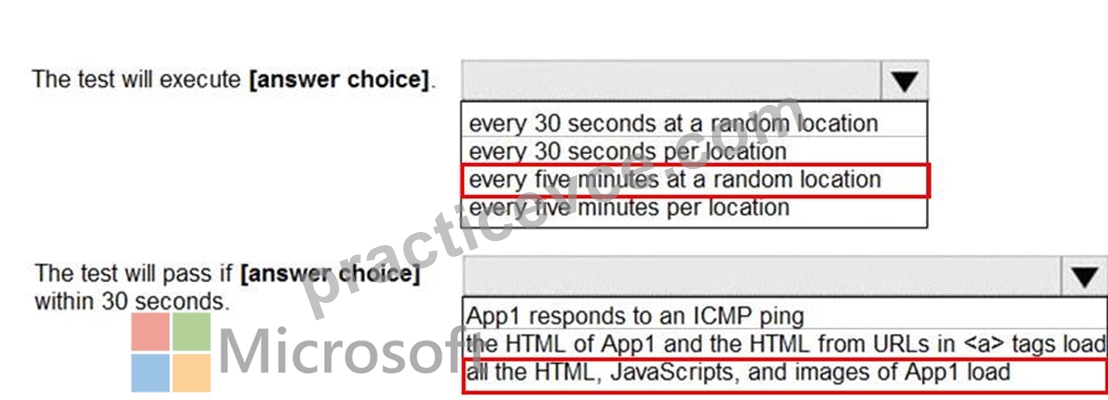
Explanation:
Box 1: every five minutes at a random location
Test frequency: Sets how often the test is run from each test location. With a default frequency of five minutes and five test locations, your site is tested on average every minute.
Box 2:
Parse dependent requests: Test requests images, scripts, style files, and other files that are part of the web page under test. The recorded response time includes the time taken to get these files. The test fails if any of these resources cannot be successfully downloaded within the timeout for the whole test.
Reference:
https://docs.microsoft.com/en-us/azure/azure-monitor/app/monitor-web-app-availability
NEW QUESTION 192
You are using GitHub as a source code repository.
You create a client-side Git hook on the commit-msg event. The hook requires that each commit message contain a custom work item tag.
You need to make a commit that does not have a work item tag.
Which git commit parameter should you use?
- A. --message ''
- B. --no-verify
- C. --no-post-rewrite
- D. --squash
Answer: B
Explanation:
Explanation
The commit-msg hook is invoked by git-commit and git-merge, and can be bypassed with the --no-verify option.
Reference:
https://git-scm.com/docs/githooks
NEW QUESTION 193
In Azure DevOps, you create Project3.
You need to meet the requirements of the project.
What should you do first?
- A. From SonarQube, create a project.
- B. From Azure DevOps, modify the build definition.
- C. From Azure DevOps, create a service endpoint.
- D. From SonarQube, obtain an authentication token.
Answer: C
Explanation:
The first thing to do is to declare your SonarQube server as a service endpoint in your VSTS/DevOps project settings.
References: https://docs.sonarqube.org/display/SCAN/Analyzing+with+SonarQube+Extension+for+vsts-TFS
NEW QUESTION 194
You are implementing an Azure DevOps strategy for mobile devices using App Center.
You plan to use distribution groups to control access to releases.
You need to create the distribution groups shown in the following table.
Which type of distribution group should you use for each group? To answer, drag the appropriate group types to the correct locations. Each group type may be used once, more than once, or not at all. You may need to drag the split bar between panes or scroll to view content.
NOTE: Each correct selection is worth one point.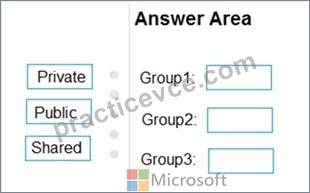
Answer:
Explanation: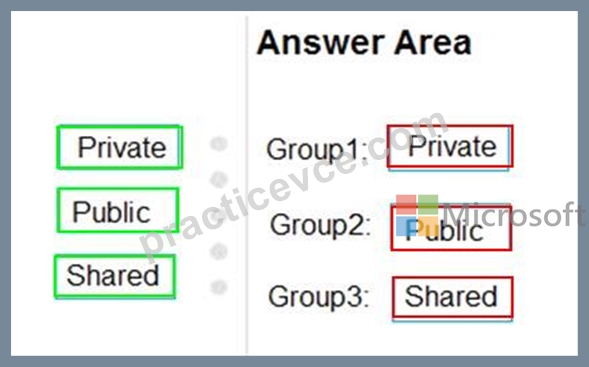
Reference:
https://docs.microsoft.com/en-us/appcenter/distribution/groups
NEW QUESTION 195
You need to use Azure Automation Sure Configuration to manage the ongoing consistency of virtual machine configurations.
Which five actions should you perform in sequence? To answer, move the appropriate actions from the list of actions to the answer area and arrange them in the correct order.
NOTE: More than one order of answer choices in correct. You writ receive credit for any of the orders you select.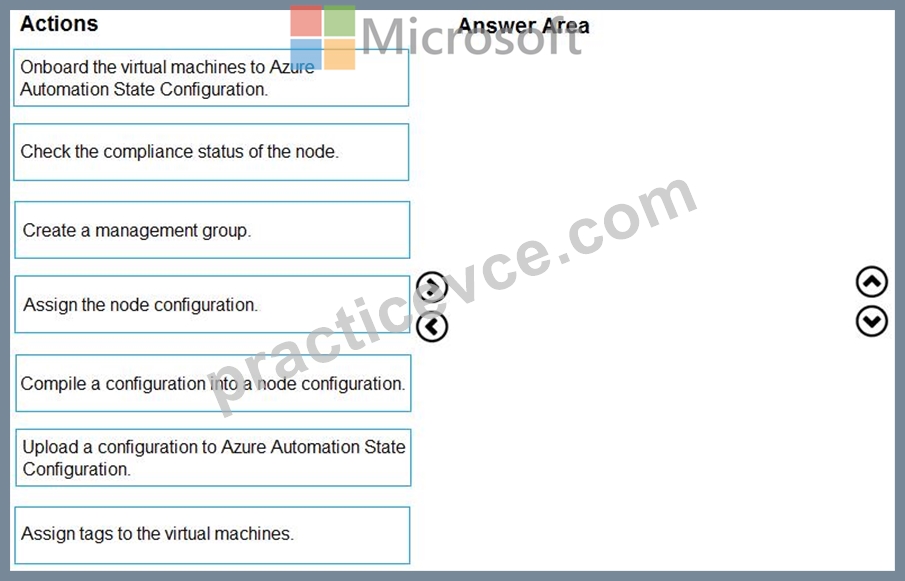
Answer:
Explanation: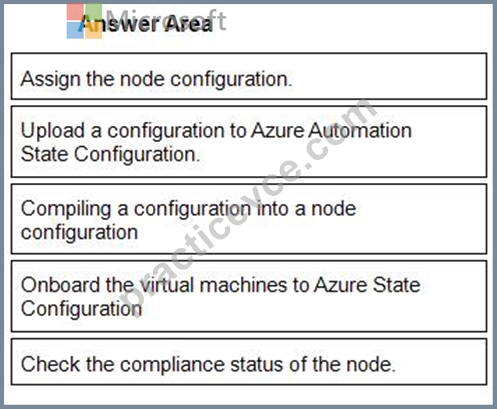
1 - Assign the node configuration.
2 - Upload a configuration to Azure Automation State Configuration.
3 - Compiling a configuration into a node configuration
4 - Onboard the virtual machines to Azure State Configuration
5 - Check the compliance status of the node.
NEW QUESTION 196
Your company uses Azure DevOps for the build pipelines and deployment pipelines of Java-based projects.
You need to recommend a strategy for managing technical debt.
Which action should you include in the recommendation?
- A. Integrate Azure DevOps and Azure DevTest Labs.
- B. Configure post-deployment approvals in the deployment pipeline.
- C. Integrate Azure DevOps and SonarQube.
Answer: C
Explanation:
Explanation
You can manage technical debt with SonarQube and Azure DevOps.
Note: Technical debt is the set of problems in a development effort that make forward progress on customer value inefficient. Technical debt saps productivity by making code hard to understand, fragile, time-consuming to change, difficult to validate, and creates unplanned work that blocks progress. Unless they are managed, technical debt can accumulate and hurt the overall quality of the software and the productivity of the development team in the long term SonarQube an open source platform for continuous inspection of code quality to perform automatic reviews with static analysis of code to:
* Detect Bugs
* Code Smells
* Security Vulnerabilities
* Centralize Quality
* What's covered in this lab
Reference:
https://azuredevopslabs.com/labs/vstsextend/sonarqube/
NEW QUESTION 197
You have a project Azure DevOps.
You plan to create a build pipeline that will deploy resources by using Azure Resource Manager templates. The templates will reference secretes stored in Azure Key Vault.
Yu need to ensure that you can dynamically generate the resource ID of the key vault during template deployment.
What should you include in the template? To answer, select eh appropriate options in the answer area.
NOTE: Each correct selection is worth one point.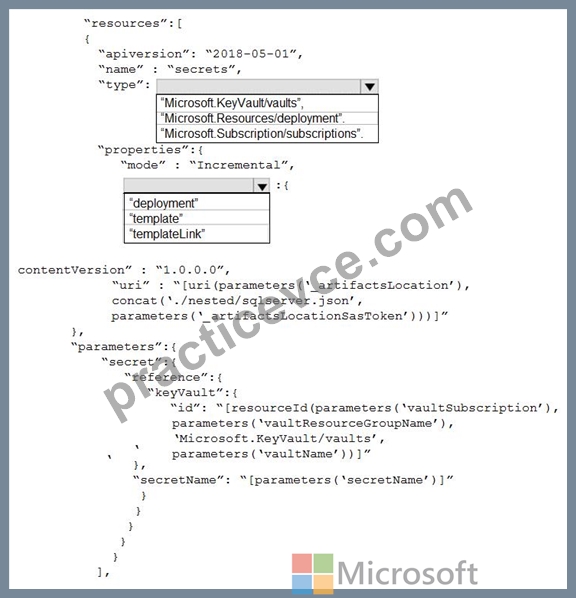
Answer:
Explanation: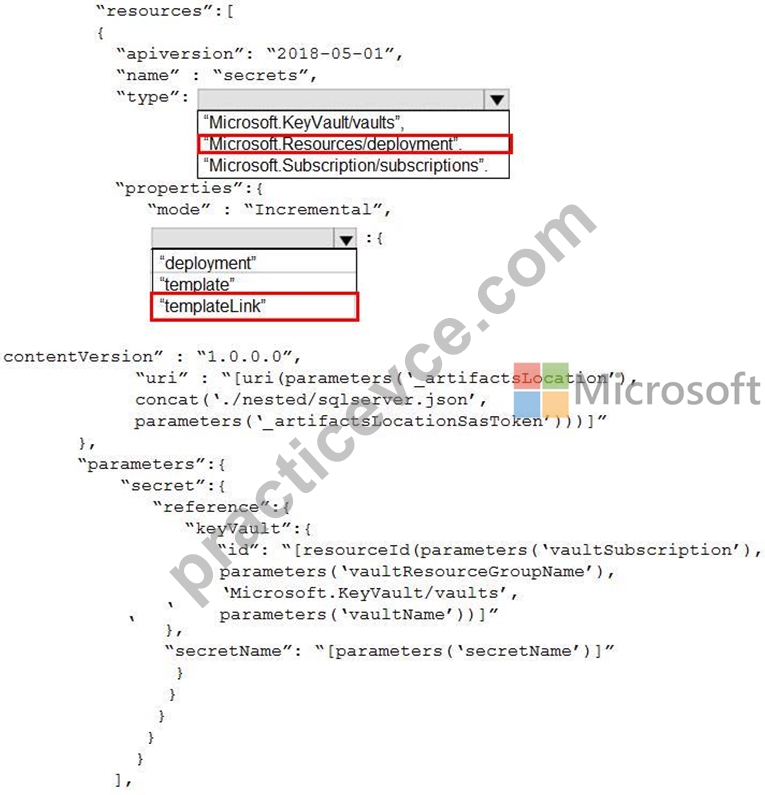
NEW QUESTION 198
You plan to deploy a website that will be hosted in two Azure regions.
You need to create an Azure Traffic Manager profile named az40011566895n1-tm in a resource group named RG1lod11566895. The solution must ensure that users will always connect to a copy of the website that is in the same country.
To complete this task, sign in to the Microsoft Azure portal.
Answer:
Explanation:
1. Go to the Azure portal, navigate to Traffic Manager profiles and click on the Add button to create a routing profile.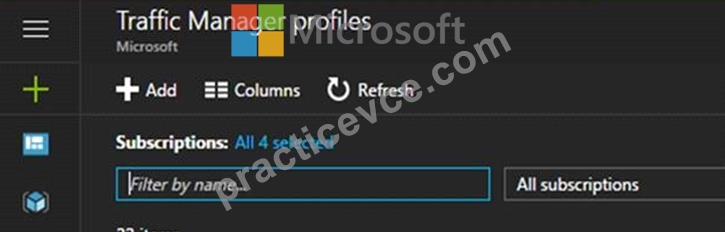
2. In the Create Traffic Manager profile, enter, or select these settings:
Name: az40011566895n1-tm
Routing method: Geographic
Resource group: RG1lod11566895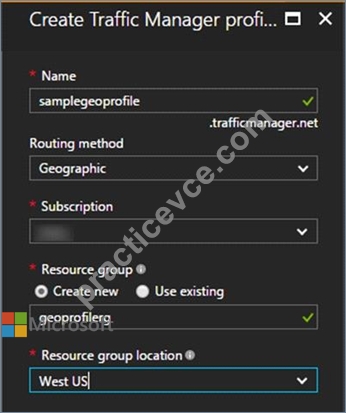
Note: Traffic Manager profiles can be configured to use the Geographic routing method so that users are directed to specific endpoints (Azure, External or Nested) based on which geographic location their DNS query originates from. This empowers Traffic Manager customers to enable scenarios where knowing a user's geographic region and routing them based on that is important.
Reference:
https://azure.microsoft.com/en-us/blog/announcing-the-general-availability-of-geographic-routing-capability-in-azure-traffic-manager/
NEW QUESTION 199
Your company uses ServiceNow for incident management.
You develop an application that runs on Azure.
The company needs to generate a ticket in ServiceNow when the application fails to authenticate.
Which Azure Log Analytics solution should you use?
- A. Automation & Control
- B. Insight & Analytics
- C. IT Service Management Connector (ITSM)
- D. Application Insights Connector
Answer: C
Explanation:
Explanation/Reference:
Explanation:
The IT Service Management Connector (ITSMC) allows you to connect Azure and a supported IT Service Management (ITSM) product/service.
ITSMC supports connections with the following ITSM tools:
ServiceNow
System Center Service Manager
Provance
Cherwell
With ITSMC, you can
Create work items in ITSM tool, based on your Azure alerts (metric alerts, Activity Log alerts and Log
Analytics alerts).
Optionally, you can sync your incident and change request data from your ITSM tool to an Azure Log
Analytics workspace.
References: https://docs.microsoft.com/en-us/azure/azure-monitor/platform/itsmc-overview
NEW QUESTION 200
......
Read Online AZ-400 Test Practice Test Questions Exam Dumps: https://vceplus.practicevce.com/Microsoft/AZ-400-practice-exam-dumps.html