

C1000-056 Updated Exam Dumps [2023] Practice Valid Exam Dumps Question
C1000-056 Sample with Accurate & Updated Questions
NEW QUESTION # 10
What command must be executed before running the mqsicreatebroker command on Linux to create an integration node?
- A. mqsiservice
- B. mqsicvp
- C. mqsiprofile
- D. mqsicommandconsole
Answer: C
Explanation:
Explanation
https://www.ibm.com/support/knowledgecenter/SSTTDS_11.0.0/com.ibm.etools.mft.doc/ae12720_.html
NEW QUESTION # 11
What is the correct order of prerequisite steps to install IBM App Connect Enterprise on IBM Cloud Private?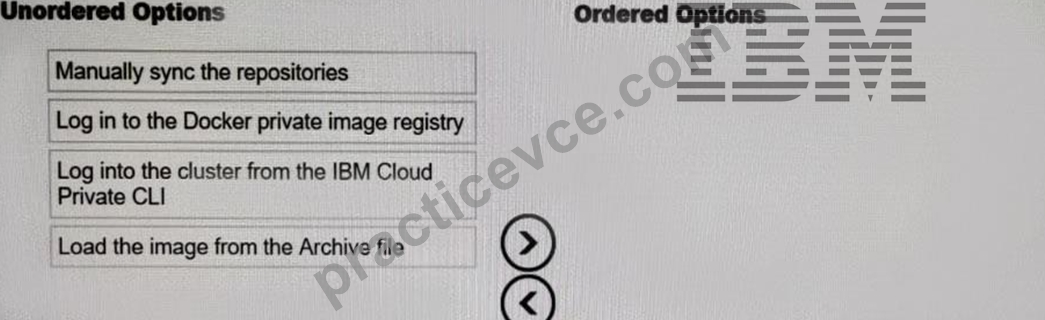
Answer:
Explanation: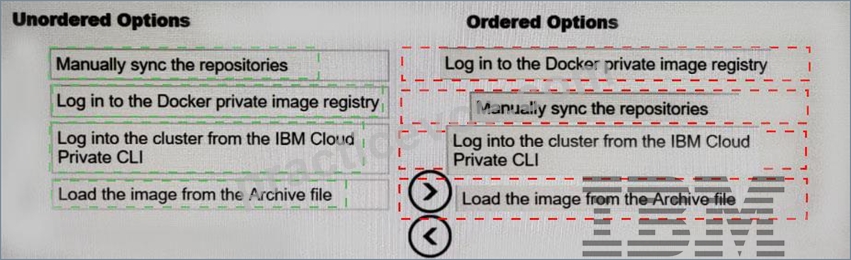
NEW QUESTION # 12
When installing IBM App Connect Enterprise for a shared installation on Linux, which group do users needed to be added to in order to gain access to the platform?
- A. mqbrkrs
- B. mqusers
- C. mqsiadmin
- D. mqnodeusers
Answer: A
Explanation:
Explanation
https://www.ibm.com/support/knowledgecenter/SSTTDS_11.0.0/com.ibm.etools.mft.doc/bh25992_.htm
NEW QUESTION # 13
When developing RESTful APIs, what is the main purpose of the RESTAsyncRequest node?
- A. Allows a REST operation request to be exposed asynchronously and return control to the client without waiting for a response C Allows a REST operation request to be exposed asynchronously and return control to the flow without waiting for a response
- B. Allows a REST request to be issued to a REST API and return control to the flow without waiting for a response
- C. Allows a REST request to be issued to a SOAP API and return control to the flow without waiting for a response
Answer: B
Explanation:
Explanation
You can use a RESTAsyncRequest node in a message flow to issue a REST request to an external REST API, and return control to the flow without waiting for a response. The response is received by a RESTAsyncResponse node, which can be in a separate message flow but must be in the same integration server. The nodes are used as a pair, and correlate responses against the original requests by using a unique identifier, which is specified on both nodes.
https://www.ibm.com/support/knowledgecenter/SSMKHH_10.0.0/com.ibm.etools.mft.doc/bz90920_.html
NEW QUESTION # 14
Once a BAR file is configured it can be deployed to which production environment?
- A. IBM API Connect
- B. IBM App Connect Professional
- C. IBM App Connect Enterprise Developer Edition
- D. IBM App Connect on IBM Cloud
Answer: D
Explanation:
Explanation
https://www.ibm.com/support/knowledgecenter/SSMKHH_10.0.0/com.ibm.etools.mft.doc/af03860_.htm
NEW QUESTION # 15
The PolicySet editor works with which file format?
- A. CSV
- B. XML
- C. TXT
- D. JSON
Answer: B
NEW QUESTION # 16
Which section in the Cloud Integration Platform Navigator should be clicked in order to install IBM MQ?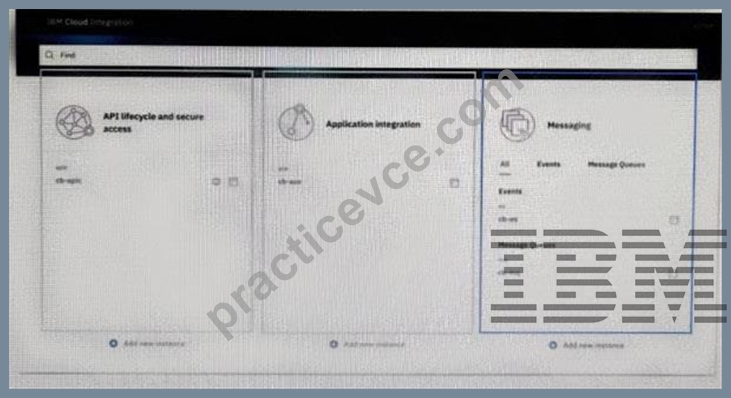
Answer:
Explanation: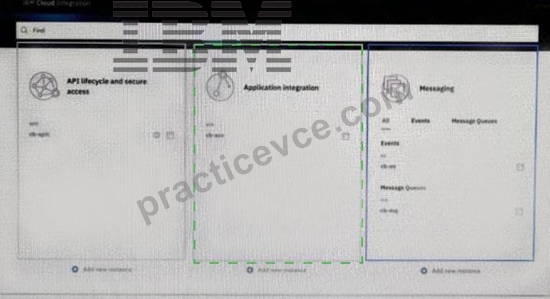
NEW QUESTION # 17
What are two purposes of a user trace?
- A. Debug message flows and integration servers
- B. Monitor user activity
- C. Detect Web-Admin login failures
- D. Provide flow usage metrics
- E. Provide more information than the administration log
Answer: A,E
NEW QUESTION # 18
What is one reason to organize resources into applications?
- A. It allows for Java and ESQL support in the same message flow
- B. It enables the ability to reference the resources in an Integration Project
- C. It provides runtime isolation of resources
- D. It enables all processes using the module to reference the latest versions
Answer: B
NEW QUESTION # 19
How can static library LIB1 be converted into a shared library without breaking references?
- A. Highlight the static library, open convert wizard create a new shared library selecting the resolve references checkbox which will update all applications, libraries, and independent resources that referenced LIB1.
- B. Use the shared library conversion tool from the Integration Toolkit
- C. Create a new shared library named TMP1, move all assets from static library, rename the static library, and rename shared library LIB1.
- D. Export static library LIB1 as a shared library, import new shared library into the workspace replacing static library with new shared LIB1.
Answer: D
NEW QUESTION # 20
An Integration Project can contain which two resource types?
- A. Integration Service
- B. Message Maps
- C. Message Flows
- D. Shared Libraries
- E. RestAPIs
Answer: B,C
Explanation:
Explanation
https://www.ibm.com/support/knowledgecenter/SSMKHH_9.0.0/com.ibm.etools.mft.doc/bc23260_.htm
NEW QUESTION # 21
Which two policies can be changed by redeploying an exisitng policy project?
- A. CICSConnection
- B. Aggregation
- C. TCPIP Client
- D. HTTPS Connector
- E. JDBC Providers
Answer: B,E
Explanation:
Explanation
https://www.ibm.com/support/knowledgecenter/SSTTDS_11.0.0/com.ibm.etools.mft.doc/py00100_.html
NEW QUESTION # 22
Which section in the Cloud Integration Platform Navigator should be clicked in order to install IBM MQ?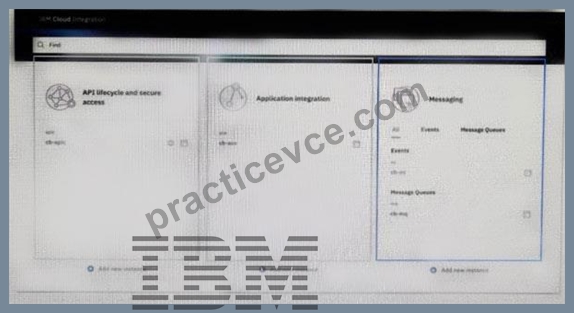
Answer:
Explanation: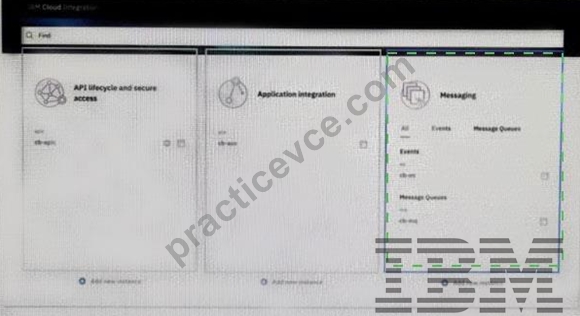
Explanation
Messages
NEW QUESTION # 23
When sharing data between a calling flow and a response flow, how can user context data be stored?
- A. In a remote database or in the local host's memory
- B. By setting a value in the Environment.CallableFlow.UserContext environment variable
- C. By setting a value in the ContextData environment variable or in a local drive
- D. On a database or in a local drive
Answer: B
Explanation:
Explanation
https://www.ibm.com/support/knowledgecenter/SSMKHH_10.0.0/com.ibm.etools.mft.doc/cl28163_.html To store user context data, you can either set a value in the Environment.CallableFlow.UserContext environment variable, or create and populate child folders below it in the message tree. For example, you can use the following command to specify context data to be stored the environment:
SET Environment.CallableFlow.UserContext = 'myData';
NEW QUESTION # 24
Which prerequisite task must be done before encrypting a connection to an MQTT server?
- A. Configure the Security identity property on the MQTT server to use encrypted message flow.
- B. Configure the MQTT server to communicate using JMT encryption.
- C. Create a connection from the MQTT server to the SSL server.
- D. Create a truststore and import the MQTT server public certificate into the truststore.
Answer: D
NEW QUESTION # 25
When splitting message flow processing between different integration servers how do the flows communicate?
- A. Using a switch server and connectivity agents
- B. Using node addresses and node configuration
- C. Using a connectivity server and switch agents
- D. Using switch addresses and node configuration
Answer: A
Explanation:
Explanation
If you are splitting processing between different integration servers, or between IBM App Connect Enterprise and IBM App Connect on IBM Cloud, your flows communicate by using a Switch server and connectivity agents.
https://www.ibm.com/support/knowledgecenter/SSTTDS_11.0.0/com.ibm.etools.mft.doc/cl23141_.htm
NEW QUESTION # 26
What node category is used to enable integrations running in IBM App Connect on IBM Cloud for performing aggregation-style operations?
- A. Transaction Nodes
- B. Callable Nodes
- C. Messaging Nodes
- D. Group Nodes
Answer: D
Explanation:
Explanation
https://developer.ibm.com/integration/blog/2018/10/08/ibm-app-connect-enterprise-now-supports-group-nodes/
NEW QUESTION # 27
In order to comply with port binding in 12-Factor App, how many integration servers should exist per container?
- A. 0
- B. 1
- C. Unlimited
- D. 2
Answer: D
NEW QUESTION # 28
Which statement is true regarding the RESTAsyncResponse node?
- A. It can be in a different integration node as the RESTAsyncRequest node
- B. It has to be in the same integration server as the RESTAsyncRequest node
- C. It can be in a separate integration server than the RESTAsyncRequest node
- D. It has to be in the same flow as the RESTAsyncRequest node
Answer: D
NEW QUESTION # 29 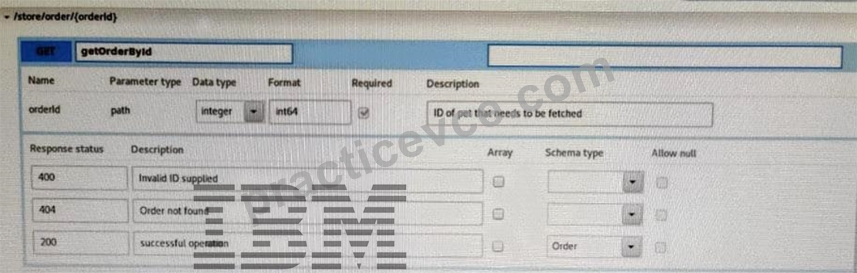
According to the API resource pictured above, there are three possible HTTP Return Codes: 400, 404, 200.
What is one way to set a HTTP Return code as 400 using ESQL?
- A. SET OutputLocalEnvironment.Reply.Transport.HTTP = 400;
- B. SET OutputLocalEnvironment.Destination.HTTP.ReplyStatusCode = 400;
- C. SET OutputLocalEnvironment.ReplyStatusCode = 400;
- D. SET OutputLocalEnvironment.REST.Reply.Transport.HTTP = 400;
Answer: B
NEW QUESTION # 30
How can an MQGet node be configured to read a message from a queue without deleting it?
- A. Set "Copy Message" property to None
- B. Check the "Read Only" property
- C. Set "Generate Mode" property to None
- D. Check the "Browse Only" property
Answer: A
NEW QUESTION # 31
When referencing a policy within a node configuration, what is the format of the reference?
- A. {PolicyProjectName}:PolicyName
- B. ApplicationName:PolicyName
- C. Policy:{PolicyName}
- D. PolicyProjectName:PolicyName
Answer: A
NEW QUESTION # 32
Where are recorded messages sent by default in the flow exerciser?
- A. They are sent to the Message Flow icon in the Flow Exerciser toolbar
- B. They are sent to the output node where each message was saved
- C. They are sent to the Recorded Messages item located in the navigator
- D. They are sent to the input node where each message was saved
Answer: B
NEW QUESTION # 33
......
IBM C1000-056 is a certification exam designed to validate the skills and knowledge of professionals who are involved in IBM App Connect Enterprise V11 Solution Development. C1000-056 exam is intended for developers who are responsible for designing, developing, and deploying solutions using IBM App Connect Enterprise V11. Candidates who pass C1000-056 exam demonstrate their expertise in using App Connect Enterprise V11 to create solutions that integrate various applications and services.
Pass IBM C1000-056 Premium Files Test Engine pdf - Free Dumps Collection: https://vceplus.practicevce.com/IBM/C1000-056-practice-exam-dumps.html