

Excellent TDA-C01 Updated 2025 Dumps With 100% Exam Passing Guarantee
Best way to practice test for Tableau TDA-C01
Tableau TDA-C01 certification exam consists of multiple-choice questions and is designed to test a candidate's knowledge and skills in using Tableau to analyze and visualize data. TDA-C01 exam covers different areas of Tableau, including data connection and preparation, visualization, analysis, and dashboard creation. Candidates will have two hours to complete the exam, and they must score at least 75% to pass. Successful candidates will receive a Tableau TDA-C01 certification, which is valid for two years and can be renewed by passing a recertification exam.
Tableau TDA-C01 certification exam is an important credential for data analysts who want to demonstrate their proficiency in using Tableau software. Tableau Certified Data Analyst certification can help data analysts stand out in a competitive job market and increase their earning potential. To prepare for the exam, data analysts should have a strong understanding of Tableau software and its various features, as well as proficiency in data analysis, visualization, and storytelling techniques.
NEW QUESTION # 64
Open the link to Book1 found on the desktop. Open the Movie Durations worksheet.
Replace the existing data source with the Netflix_2019 data source.
Answer:
Explanation:
check the steps below in explanation
Explanation:
To replace the existing data source with the Netflix_2019 data source, you need to do the following steps:
Open the link to Book1 found on the desktop. This will open the Tableau workbook that contains the Movie Durations worksheet.
Click on the Movie Durations tab at the bottom of the workbook to open the worksheet. You will see a bar chart that shows the number of movies by duration for the existing data source.
Go to the Data Source tab at the bottom of the workbook to see the data source page. You will see a table that shows the fields and values from the existing data source.
Click on the drop-down arrow next to the data source name at the top of the page and select Replace Data Source from the menu. This will open a dialog box that allows you to replace your data source with another one.
Select Netflix_2019 from the list of available data sources and click OK. This will replace your existing data source with the Netflix_2019 data source and update your worksheet accordingly. You may need to fix any broken fields or calculations that result from the replacement.
NEW QUESTION # 65
You have the following dashboard.
When a user selects a only on the map the data on the bar chart must show only the data for the selected city. The data in the bar chart must change only when the user selects a different city How should you configure the dashboard action? (Use the dropdowns in the Answers Area to select the correct options.)
Answer:
Explanation:
NEW QUESTION # 66
You have a data source that contains data tor every city in the Unites States. The following is a sample of the data.
You need to use the City dimension to create a dynamic filter that snows the cities that have a population greater than one million Which type of filter should you use?
- A. General filter
- B. Wildcard filter
- C. Condition filter
- D. Top filter
Answer: C
Explanation:
To use the City dimension to create a dynamic filter that shows the cities that have a population greater than one million, you should use a condition filter. A condition filter is a type of filter that shows only the values that meet a specified condition based on a measure or a calculation. You can create a condition filter by dragging a dimension to the Filters shelf and selecting Condition from the dialog box. Then you can enter a formula or choose an option that defines your condition.
In this case, you want to create a condition filter based on Population, which is a measure. You can drag City to the Filters shelf and select Condition from the dialog box. Then you can choose By field from the tab and select Population > Sum > Greater than > 1000000 from the drop-down lists. This will create a condition filter that shows only the cities that have a sum of population greater than one million.
The other options are not correct for this scenario. A general filter is not a specific type of filter, but a term that refers to any type of filter in Tableau. A wildcard filter is a type of filter that shows only the values that match a specified pattern or string, such as "New*" or "*ton". A top filter is a type of filter that shows only the top or bottom N values of a measure or dimension based on a ranking or an aggregation. References:
https://help.tableau.com/current/pro/desktop/en-us/filtering.htm
https://help.tableau.com/current/pro/desktop/en-us/filtering_condition.htm
https://help.tableau.com/current/pro/desktop/en-us/filtering_wildcard.htm
https://help.tableau.com/current/pro/desktop/en-us/filtering_topn.htm
NEW QUESTION # 67
You plan to create a visualization that has a dual axis chart. The dual axis chart will contain a shape chart and a line chart will use the same measure named Population on the axis.
You need to configure be shapes to be much larger than the line.
What should you do?
- A. Create a custom shape that is larger than the default shape and add the shape to the Shapes folder in My Repository
- B. Change Population to a discrete dimension
- C. Duplicate Population Drag the duplicate to the second Marks card and configure the see of the marks independently
- D. For the second axis select Shape on the Marks card From Select Shape Palette select Custom and then select Reset
Answer: C
Explanation:
To configure the shapes to be much larger than the line, you need to duplicate Population and drag it to the second Marks card. This will create a dual axis chart with two measures on one axis. You can then select Shape on one Marks card and Line on another Marks card, and adjust the size of each mark independently using the Size slider or menu. References:
https://help.tableau.com/current/pro/desktop/en-us/multiplemeasures_dualaxes.htm
https://help.tableau.com/current/pro/desktop/en-us/marks_markproperties_size.htm In a dual-axis chart in Tableau, if you want to have two different visual mark types (like a shape and a line) and configure them differently (such as making one larger than the other), you would need to duplicate the measure. You then drag this duplicate to the second Marks card (which represents the second axis). There, you can adjust the size of the marks (shapes, in this case) independently of the line marks on the first Marks card.
NEW QUESTION # 68
You have a sales dataset that contains the following fields.
You need to analyze the average revenue per product in different regions over time.
Which two fields should be measures? Choose two.
- A. Product Name
- B. Order Date
- C. Quantity
- D. Revenue
- E. Customer Region
Answer: C,D
Explanation:
To analyze the average revenue per product in different regions over time, you need to use two fields that contain numeric, quantitative values that you can measure and aggregate. Quantity and Revenue are both measures that fit this criterion. You can multiply Quantity and Revenue to get the total sales for each product, and then divide by the number of products to get the average revenue. You can also use these measures to create charts and tables that show the trends and comparisons over time and across regions. References:
Dimensions and Measures, Blue and Green - Tableau
Tableau Certified Data Analyst Study Guide
NEW QUESTION # 69
You company has two divisions located in the United States and Germany Bach division has a separate database. The following is a sample of the sales data for the division in the United States.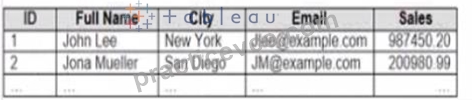
The following is a sample of the sales data for me division in Germany.
You have population data in a file named Populatio.csv. the following is a sample of the data.
You plan to create a visualization that ml show tie sales per capita for each salesperson Each salesperson must be identified by identified by their full name.
You need to prepare the data to support the planned visualization. The data source must support being published .
Which four actions should you perform in order?
(Place the four correct options n order Use the arrows to move Options to Answer Area arrows to re-order the options.
Use Answer Area arrows to re-order the options)
Answer:
Explanation:
1 - Open Tableau Prep
2 - Union the sales data of both divisions
3 - Create a new column to concatenate the name for the Germany division
4 - Join the sales data and the population data by using Country as the join field
NEW QUESTION # 70
You publish a dashboard tut uses an attract. The extract refreshes every Monday at 10:00.
You need to ensure that the extract also refreshes on the last day of the month at 18:00.
What should you do?
- A. From Tableau Server select the workbook select Refresh Extracts and then add a new extract refresh
- B. From Tableau Server. select Schedules find the schedule of the extract, and change the frequency to the Last day of the month
- C. From Tableau Server. select Schedules and change the priority of the existing schedule
- D. From Tableau Desktop, open the Publish Workbook dialog box and configure the schedule.
Answer: A
Explanation:
To refresh an extract on Tableau Server, you need to select the workbook, select Refresh Extracts, and then add a new extract refresh. You can specify the frequency and time of the refresh, as well as any custom options. You can have multiple extract refreshes for the same workbook with different schedules. Reference: https://help.tableau.com/current/server/en-us/refresh_extracts.htm https://help.tableau.com/current/server/en-us/refresh_extracts_add.htm
NEW QUESTION # 71
You have a data source that contains the following columns.
You want to filter regions based on the highest sales. Users must be able to specify the number of regions shown.
Which three actions should you perform in order? (Place the three correct options in order. Use the arrows to move Options to Answer Area.
Use Answer Area arrows to re-order the options.)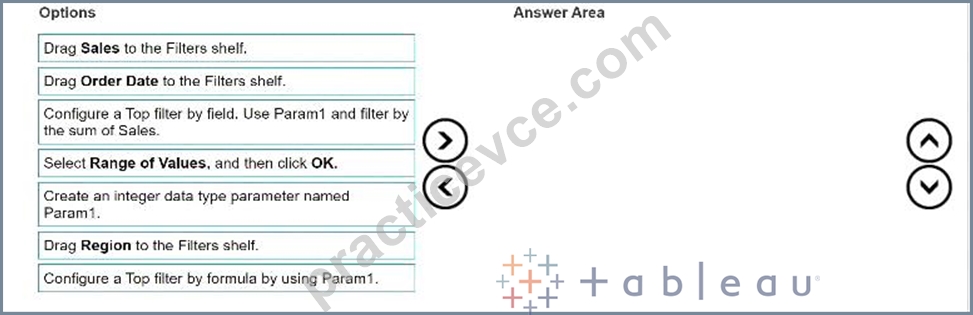
Answer:
Explanation:
Explanation:
To filter regions based on the highest sales and allow users to specify the number of regions shown, you should perform these actions in order:
Answer area:
Create an integer data type parameter named Param1.
Drag Region to the Filters shelf.
Configure a Top filter by field. Use Param1 and filter by the sum of Sales.
To create a dynamic filter that lets users choose the number of regions to display, you need to use a parameter and a top filter. A parameter is a user-defined variable that can be used in calculations, filters, and reference lines. A top filter is a type of filter that shows only the top or bottom N values based on a specified field or expression.
In this question, you want to filter regions based on the highest sales. You also want users to be able to specify the number of regions shown. To achieve this, you need to follow these steps:
First, you need to create an integer data type parameter named Param1. This parameter will allow users to enter a number that will determine how many regions to show. You can create a parameter by right-clicking on the Data pane and selecting Create Parameter. Then, you need to specify the name, data type, current value, and allowable values for the parameter. In this case, you can choose Integer as the data type, 10 as the current value, and All as the allowable values. You also need to show the parameter control by right-clicking on the parameter and selecting Show Parameter Control. This will display a slider or a text box where users can enter or adjust the parameter value.
Next, you need to drag Region to the Filters shelf. This will open the Filter dialog box, where you can choose how to filter the Region field. You can filter by general, wildcard, condition, or top. In this case, you want to filter by top, so you need to select the Top tab.
Finally, you need to configure a top filter by field. Use Param1 and filter by the sum of Sales. This will filter the Region field by showing only the top N regions based on the sum of Sales, where N is the value of the parameter Param1. You can configure a top filter by field by selecting By field in the Top tab, then choosing the parameter Param1 from the drop-down list, and selecting the aggregation function Sum and the field Sales from the other drop-down lists. This will create a filter expression that looks like this: Top Param1 by SUM(Sales).
By following these steps, you will create a filter that shows only the regions with the highest sales, and allows users to change the number of regions shown by adjusting the parameter value.
References:
Tableau Certified Data Analyst Exam Prep Guide, page 10, section "Filtering Data" Tableau Help: Parameters Tableau Help: Top Filters
NEW QUESTION # 72
You have two data sources that use the same schema One data source contains order data from 2019 and the other data source contains order data from 2020.
You have a worksheet that shows the orders from 2019.
You need to configure the worksheet to show the orders from 2020 without reloading the data.
Which option should you select?
Answer:
Explanation:
Explanation:
Replace Data Source
Replace Data Source is a feature that allows you to replace one data source with another one that has the same or similar fields and structure. It updates all the worksheets that use the original data source with the new one, without reloading the data. In this case, you want to replace the data source that contains order data from 2019 with the one that contains order data from 2020.
To replace the data source, you need to do the following steps:
Go to the Data Source tab at the bottom of the workbook to see the data source page. You will see a table that shows the fields and values from the original data source.
Click on the drop-down arrow next to the data source name at the top of the page and select Replace Data Source from the menu. This will open a dialog box that allows you to replace your data source with another one.
Select the data source that contains order data from 2020 from the list of available data sources and click OK. This will replace your original data source with the new one and update your worksheet accordingly. You may need to fix any broken fields or calculations that result from the replacement.
References: https://help.tableau.com/current/pro/desktop/en-us/datasource_replace.htm
https://help.tableau.com/current/pro/desktop/en-us/datasource_replace_workbook.htm
NEW QUESTION # 73
Open the Link to Book1 found on the desktop. Open Map worksheet and use Superstore data source.
Create a filed map to show the distribution of total Sales by State across the United States.
- A. check the steps below in explanation
Answer: A
Explanation:
To create a filled map to show the distribution of total Sales by State across the United States, you need to do the following steps:
Open the link to Book1 found on the desktop. This will open the Tableau workbook that uses the Superstore data source.
Click on the Map tab at the bottom of the workbook to open the Map worksheet. You will see a blank worksheet with no marks.
Drag State from the Dimensions pane to Detail on the Marks card. This will create a map that shows each state as a mark. You may need to zoom in or out to see the whole map.
Drag Sales from the Measures pane to Color on the Marks card. This will create a filled map that shows the distribution of total Sales by State across the United States. The color legend will show you the range of values and colors for Sales.
Optionally, you can adjust the color scheme, transparency, size, and borders of the marks by clicking on the Color menu on the Marks card. You can also add labels, tooltips, or filters to enhance your map.
NEW QUESTION # 74
Refer to the exhibit.
You need the top 10 values to appear in a different color. The lop 10 values must be colored dynamically.
What should you do?
- A. Create a set that has a top 10 condition, and then drag the set to Color on the Marks card.
- B. Create a group field that groups the top 10 values into one group and the rest of the values into another group. Drag the group field to Color on the Marks card.
- C. Select the lop 10 bars, create a set. and then drag the set to Color on the Marks card.
- D. Select the top 10 bars, and then change the color by selecting Color on the Marks card.
Answer: A
NEW QUESTION # 75
You have the following view.
You want to filter the view lo show only records that have a movie name starting with the word. "The". You must achieve the goal without writing any formulas.
Which type of filter should you use?
- A. Top
- B. General
- C. Condition
- D. Wildcard
Answer: D
NEW QUESTION # 76
You have the following dataset.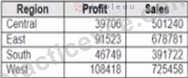
You need to create the following worksheet.
The table must show either profit or sales based on the selection from the Parameter 1 menu.
Which three actions should you perform in orders
(Place the three correct options in order Use the arrows to move Options lo Answer Area Use Answer Area arrows to reorder the options)
Answer:
Explanation:
1 - Create a parameter that has list string values of profit and sales. Select Show Parameter.
2 - Create a calculated field that uses the following formula,,,,,,
3 - Drag the calculated field to Detail on the Marks card and add Region to the Columns sheif.
NEW QUESTION # 77
You have the following dataset in Microsoft Excel.
You are using interpreter to cleans the dataset. Data interpreter provides the following results.
How many rows of data will be ingested into Tableau as values?
- A. 0
- B. 1
- C. 2
- D. 3
Answer: D
Explanation:
Data interpreter is a feature that helps you clean and structure your data in Excel before importing it into Tableau. It detects and removes any headers, footers, subtotals, or other elements that are not part of the actual data. It also splits any merged cells and fills in any missing values. In this case, data interpreter provides the following results:
It removes the first three rows and the last two rows that contain headers and footers.
It splits the merged cells in column A and fills in the missing values with "Fiction" or "Non-Fiction".
It does not remove or change any other rows or cells.
Therefore, the number of rows of data that will be ingested into Tableau as values is 17, which is the number of rows left after removing the headers and footers. Reference: https://help.tableau.com/current/pro/desktop/en-us/importing_cleaning_up_data.htm https://help.tableau.com/current/pro/desktop/en-us/importing_data_interpreter.htm
NEW QUESTION # 78
You have the following tiled dashboard that has one sheet.
You want to replace the sheet with Sheet2.
What should you do?
- A. Drag Sheet2 to the dashboard.
- B. Right-click Sheet2 and select Add to Dashboard.
- C. From the context menu of Sheet3, select Deselect.
- D. From the context menu of Sheet3, select Remove Dashboard Item.
- E. Select Sheet3 and click the Swap Sheet button next to Sheet2.
Answer: A
Explanation:
In Tableau, to replace a sheet on a dashboard, you can simply drag the desired sheet (Sheet2 in this case) from the sheets list onto the dashboard where the current sheet (Sheet3) is. This will replace the existing visualization with the new one.
NEW QUESTION # 79
You have the following dataset:
You want to create a parameter to dynamically filter the data to produce the following results.
Which two types of parameters can you use to produce the results? Choose two.
- A. Float
- B. String
- C. Integer
- D. Datetime
- E. Date
- F. Boolean
Answer: B,C
Explanation:
In the context of filtering data in Tableau, both string and integer parameters can be used to dynamically filter data. A string parameter can be used to filter text-based values, while an integer parameter is suitable for numerical values. In the provided dataset and result URLs, it appears that a unique identifier or key (which could be a string or integer) is being used to filter specific data entries. References: The information is based on the following sources:
An Introduction to Parameters in Tableau
Create Parameters - Tableau
NEW QUESTION # 80
You have the following dashboard that contains two visualizations.
You want to show only visualization at time. Users must be able to switch between visualizations.
What should you me?
- A. Showhide buttons
- B. A parameter and a calculated filed
- C. Worksheet actions
- D. Dashboard actions
Answer: A
Explanation:
Showhide buttons are a feature that allows you to show or hide a layout container on a dashboard. You can use showhide buttons to create a toggle effect that switches between two visualizations. You need to place each visualization in a separate layout container and then add a showhide button for each container. You can customize the appearance and behavior of the buttons to suit your needs. Reference: https://help.tableau.com/current/pro/desktop/en-us/dashboards_organize_floating_layoutcontainers.htm https://help.tableau.com/current/pro/desktop/en-us/dashboards_showhide.htm
NEW QUESTION # 81
You have the following visualization.
You Create a table calculation named Rank_Score that has a formula of RANK(AVG([Score]), and you drag Rank_Score to Text on the Marks cards.
What is the Rank Score value for Student ID 4220?
- A. 0
- B. 1
- C. 2
- D. 3
Answer: B
Explanation:
the rank function returns the rank of each row within the partition of a result set. The rank of a row is one plus the number of ranks that come before the row in question.
To answer your question, we need to apply the rank function to the Avg Score column and sort it in descending order. Then we can find the rank score value for Student ID 4220 by looking at the corresponding row.
Here is how the table would look like after applying the rank function and sorting:
As you can see, the rank score value for Student ID 4220 is 1.
NEW QUESTION # 82
You have the following dataset.
Which grouping option should you use m Tableau Prep to group al five names automatically?
- A. Spelling
- B. Common Characters
- C. Pronunciation
- D. Manual Selection
Answer: D
NEW QUESTION # 83
You have the following visualization.
You Create a table calculation named Rank_Score that has a formula of RANK(AVG([Score]), and you drag Rank_Score to Text on the Marks cards.
What is the Rank Score value for Student ID 4220?
- A. 0
- B. 1
- C. 2
- D. 3
Answer: A
Explanation:
the rank function returns the rank of each row within the partition of a result set. The rank of a row is one plus the number of ranks that come before the row in question.
To answer your question, we need to apply the rank function to the Avg Score column and sort it in descending order. Then we can find the rank score value for Student ID 4220 by looking at the corresponding row.
Here is how the table would look like after applying the rank function and sorting:
As you can see, the rank score value for Student ID 4220 is 1.
NEW QUESTION # 84
You want to connect a Tableau workbook to a dataset in a Microsoft Excel spreadsheet.
What should you do from Tableau Desktop?
- A. From the File menu select New
- B. From the Data menu select Replace Data Source
- C. From the File menu select Import Workbook
- D. From the Data menu select New Data Source
Answer: A
NEW QUESTION # 85
You create a parameter named Choose Region fiat contains values from a field named Region.
You want users to be able to use the Choose Region parameter to interact with a chart by logging between different regions What should you do next?
- A. Add Region to the Fitters card
- B. Add the Choose Region parameter to the Pages card
- C. Add the [Region] = [choose Region) formula to the Filters card
- D. Set the Choose Region parameter to Single Value (list)
Answer: C
Explanation:
https://kb.tableau.com/articles/howto/filtering-data-with-a-parameter?lang=fr-fr After creating a parameter named Choose Region, you want to use it to filter the chart based on the user's selection. To do this, you would create a calculated field with the formula [Region] = [Choose Region] and add this calculated field to the Filters card. This will dynamically filter the chart to display data only for the region that matches the user's selection in the Choose Region parameter.
NEW QUESTION # 86
You have a data source that contains 20 tables.
You want the tables to be organized within the Data pane based on the type of data contained within the tables.
What should you use?
- A. Groups
- B. Hierarchies
- C. Sets
- D. Folders
Answer: D
Explanation:
To organize the tables in the Data pane based on the type of data contained within the tables, you should use folders. Folders are a way to manually group fields, parameters, sets, or tables in the Data pane according to your preference. You can create folders by right-clicking on the fields or tables you want to group and selecting Folders > Create Folder. You can also drag and drop fields or tables into existing folders. You can name the folders according to the type of data they contain, such as sales, customer, product, etc. Folders can help you find and access the fields or tables you need more easily and efficiently. References:
Organize and Customize Fields in the Data Pane - Tableau
Tableau Certified Data Analyst Study Guide
NEW QUESTION # 87
You have a workbook that connects to a database. The database requires authentication.
You plan to publish the workbook and schedule a daily refresh of the data.
Which two conditions must be met to schedule the refresh? Choose two.
- A. The credentials must be embedded.
- B. The data source must use a live connection.
- C. The data must be extracted.
- D. The data source must be stored as a hyper file.
Answer: A,C
NEW QUESTION # 88
You have the following tiled dashboard that has one sheet.
You want to replace the sheet with Sheet2.
What should you do?
- A. Drag Sheet2 to the dashboard.
- B. Right-click Sheet2 and select Add to Dashboard.
- C. From the context menu of Sheet3. select Remove Dashboard item
- D. From the context menu of Sheet3. select Deselect
- E. Select Sheet3 and click the Swap Sheet button next to Sheet2.
Answer: A
Explanation:
In Tableau, to replace a sheet on a dashboard, you can simply drag the desired sheet (Sheet2 in this case) from the sheets list onto the dashboard area where the current sheet (Sheet3) resides. This action will replace the existing sheet with the new one. Right-clicking and adding to the dashboard adds an additional sheet rather than replacing, and the context menu options mentioned in the other choices are not the standard methods for replacing sheets within a dashboard.
NEW QUESTION # 89
......
Tableau Certified Data Analyst Certification Sample Questions and Practice Exam: https://vceplus.practicevce.com/Tableau/TDA-C01-practice-exam-dumps.html