

[Feb-2022] Verified Nokia 4A0-C02 Bundle Real Exam Dumps PDF
4A0-C02 Dumps PDF New [2022] Ultimate Study Guide
Nokia 4A0-C02 Exam Syllabus Topics:
| Topic | Details |
|---|---|
| Topic 1 |
|
| Topic 2 |
|
| Topic 3 |
|
| Topic 4 |
|
| Topic 5 |
|
| Topic 6 |
|
| Topic 7 |
|
| Topic 8 |
|
| Topic 9 |
|
NEW QUESTION 277
Click the exhibit.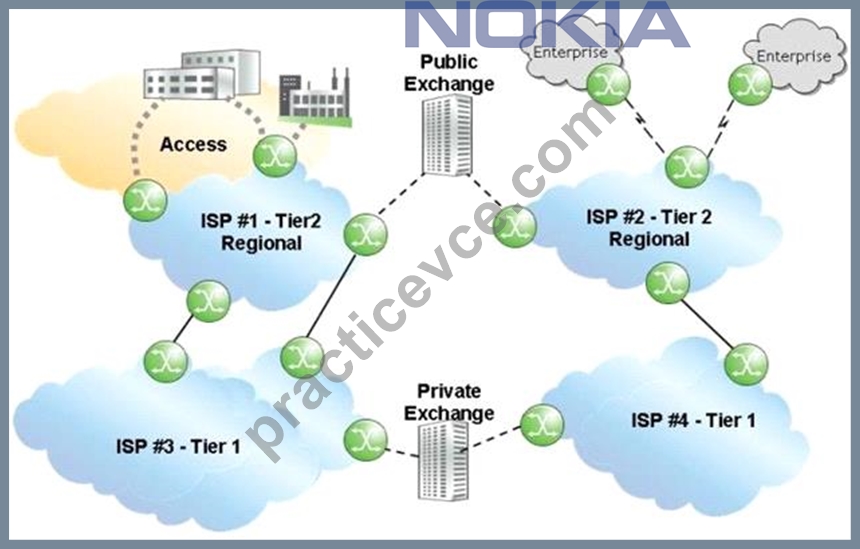
Which of the following about the relationship between ISP 1 and ISP 3 is TRUE?
- A. ISP 3 is downstream from ISP 1 and is expected to push more traffic toward ISP 1 than it pulls from it.
- B. ISP 1 is downstream from ISP 3 and is expected to push more traffic toward ISP 3 than it pulls from it.
- C. ISP 3 is downstream from ISP1 and is expected to pull more traffic from ISP 1 than it pushes toward it.
- D. ISP 1 is downstream from ISP 3 and is expected to pull more traffic from ISP 3 than it pushes toward it.
Answer: D
NEW QUESTION 278
A CE hub and spoke VPRN has two spoke sites; which of the following would be the best option to implement this topology at the hub site PE?
- A. One VPRN, one route distinguisher, and two route targets
- B. Two VPRNs, one route distinguisher, and three route targets
- C. Two VPRNs, two route distinguishers, and three route targets
- D. One VPRN, two route distinguishers, and three route targets
Answer: A
NEW QUESTION 279
Which of the following about VPRN Outbound Route Filtering (ORF) is FALSE?
- A. BGP ORF is most effective when a large number of routes is being exchanged between two peers, and most routes are filtered out on arrival.
- B. A PE indicates its ORF capabilities to its neighbor PE in a BGP Open message.
- C. Resources consumed at the sender and receiver PEs can be reduced by using BGP ORF.
- D. BGP ORF allows a receiving PE to filter out unnecessary inbound routes.
Answer: D
NEW QUESTION 280
Click the exhibit button below. Given the output of the #show pools 1/2/2 network-egress command on a GigE port, what can the service provider deduce? (Choose two)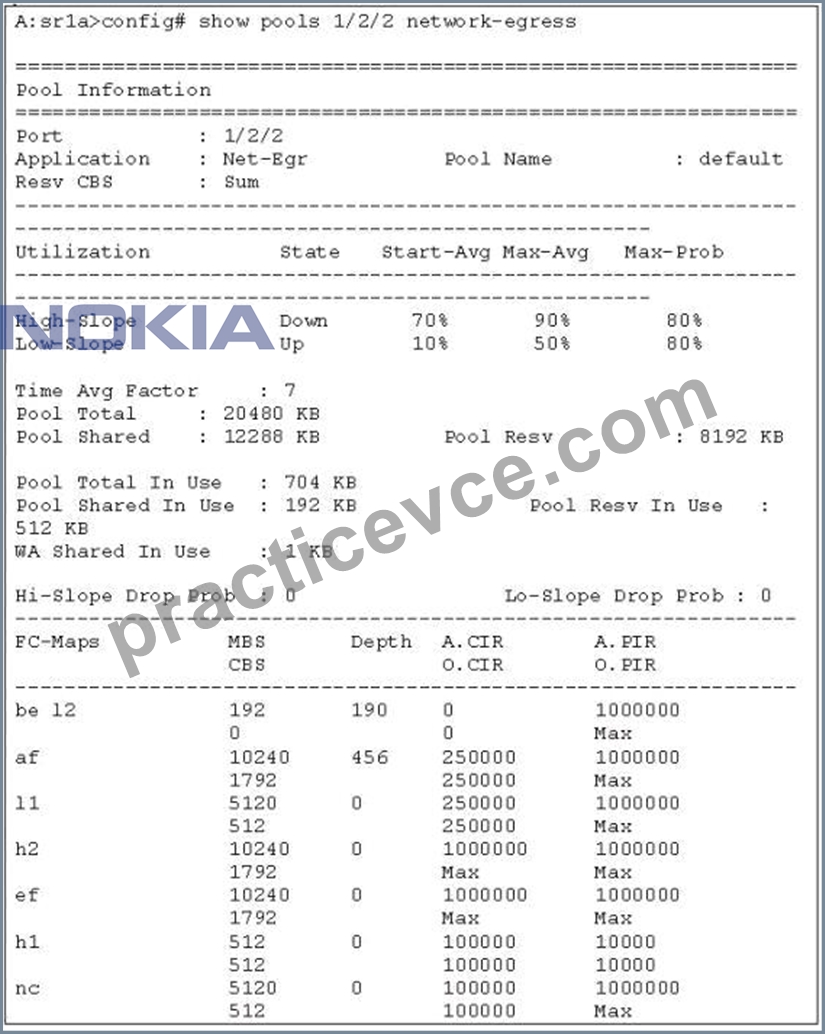
- A. QoS is not configured on the router.
- B. Traffic belonging to forwarding class "11 "will never make use of the shared buffer pool.
- C. Out-of-profile traffic in the shared buffer pool is being dropped.
- D. Packets in forwarding classes "be" and "12" are being queued.
- E. Traffic belonging to forwarding class "ef" is not experiencing queuing delays.
Answer: D,E
NEW QUESTION 281
Based on queue usage, which of the following QoS-policies when combined will allow queue rates to be dynamically allocated? (Choose two)
- A. The scheduler-policy
- B. The slope-policy
- C. The network-queue policy
- D. The WRED-policy
- E. The SAP-ingress policy
- F. The arbitrator-policy
- G. The network-policy
Answer: A,E
NEW QUESTION 282
On a PE router, the VRF table for VPRN 10 contains: one local route, two BGP routes learned from a local CE. and three tunneled routes learned from a remote site. If we execute the command "configure service vprn 10 maximum-routes 2 log-only" on this PE router, how many routes are expected to be in the VRF?
- A. Five routes: the local route, the two BGP routes learned from the local CE, and two tunneled routes.
- B. Two routes: the local route and one BGP route learned from the local CE.
- C. Two routes: the local route and one tunneled route.
- D. Six routes: the local route, the two BGP routes learned from the local CE, and three tunneled routes.
- E. Three routes: the local route and two tunneled routes.
Answer: D
NEW QUESTION 283
Click on the exhibit.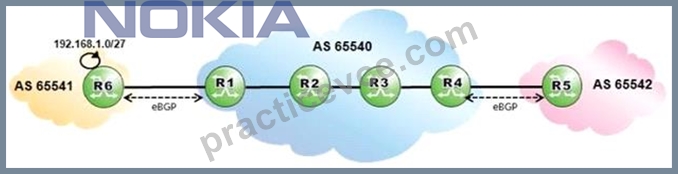
AS 65540 is using MPLS to provide BGP shortcuts for its iBGP routing. AS 65541 is advertising prefix 192.168.1.0/27 into BGP. Which routers have the BGP update for the advertised prefix in their BGP table?
- A. Routers R1, R2, R3 and R4 only.
- B. Routers R1, R2, R3, R4 and R5.
- C. Routers R1, R4 and R5 only.
- D. Routers R1and R4 only.
Answer: C
NEW QUESTION 284
Which of the following functions must a PE router support when participating in a VPLS service? (Choose 3)
- A. Frame replication
- B. Frame forwarding
- C. MSTP
- D. Frame fragmentation
- E. MAC learning
- F. Must discard frames with an unknown destination MAC
Answer: A,B,E
NEW QUESTION 285
Which of the following is a true statement?
- A. There is no relationship between the age-time and the amount of flooding.
- B. The lower the age-time, the greater the amount of flooding
- C. The lower the age-time, the lower the amount of flooding.
- D. The higher the age-time, the greater the amount of flooding.
Answer: B
NEW QUESTION 286
In a VPRN the PE device is configured to run which of the following protocols? (Choose three.)
- A. MPLS for exchanging labels with the CE devices
- B. A label signaling protocol for defining transport tunnels between PE and CE devices
- C. Targeted LDP for exchanging VPRN labels with other PE devices
- D. A routing protocol for exchanging customer routes with the CE
- E. MP-BGP for exchanging customer routes with other PEs
- F. MPLS for exchanging labels with other provider core devices
Answer: D,E,F
NEW QUESTION 287
When configuring BGP as the PE-CE protocol on an Alcatel-Lucent 7750 SR, the configuration on the CE is done under the ____________ context and the PE configuration is under the ____________ context.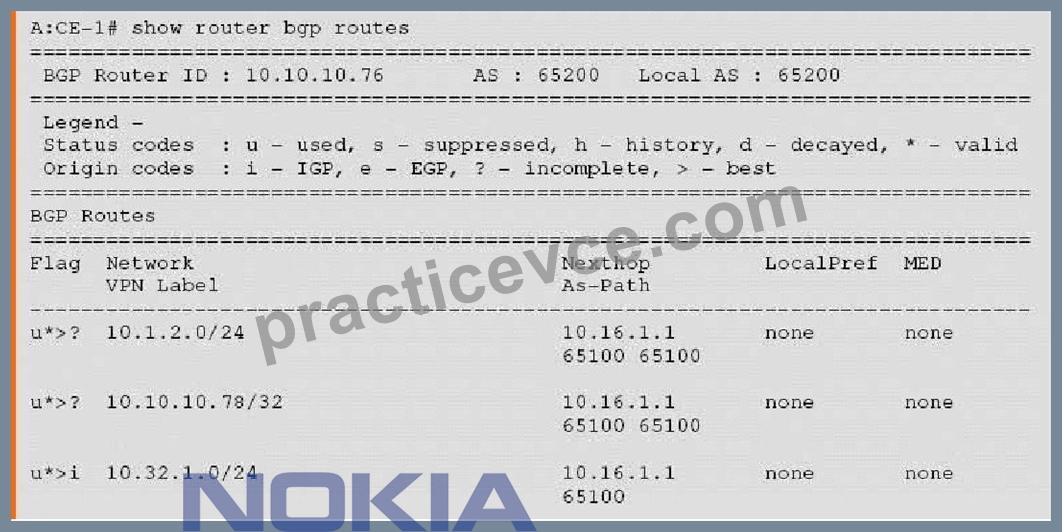
- A. Router, router
- B. Global, router
- C. Router, service
- D. Router, global
- E. Service, router
- F. Service, service
Answer: C
NEW QUESTION 288
Two Alcatel-Lucent 7750 SRs are established BGP peers with the following add-paths configuration:
R1: configure router bgp add-paths ipv4 send 4 receive
R2: configure router bgp add-paths ipv4 send 2
If router R1 advertises three routes for a given prefix X, how many routes is router R2 expected to have for prefix X?
- A. 0
- B. None
- C. 1
- D. 2
Answer: C
NEW QUESTION 289
If Route Reflector 1 (RR1) is used for Internet routes, and Route Reflector 2 (RR2) is used for VPN routes, which of the following is TRUE?
- A. BGP sessions established between RR1 and the PEs support the IPv4 address family only.
- B. BGP sessions established between RR2 and the PEs support the IPv4 address family only.
- C. BGP sessions established between RR1 and the PEs support IPv4 and VPN-IPv4 address families.
- D. BGP sessions established between RR2 and the PEs support IPv4 and VPN-IPv4 address families.
Answer: A
NEW QUESTION 290
Click the exhibit.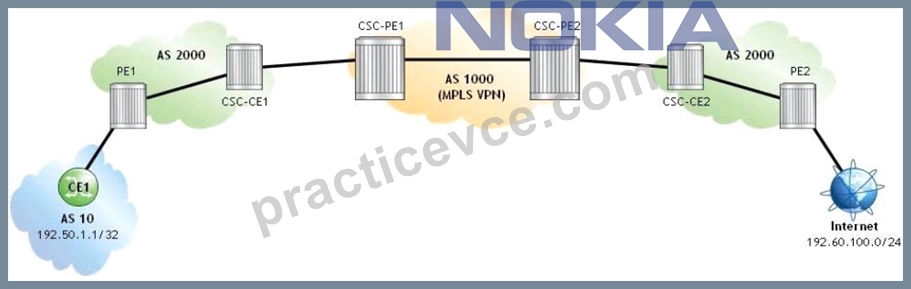
A Carrier Supporting Carrier (CSC) VPRN is configured on an Alcatel-Lucent 7750 SR for a customer carrier who is an Internet Service Provider (ISP). Which of the following configuration steps is NOT required?
- A. Configuring iBGP sessions between PEs residing in different customer carrier sites.
- B. Configuring a policy on each CSC-CE to advertise local PE addresses to the network provider.
- C. Configuring an IES service on PEL
- D. Configuring a CSC VPRN on each CSC-PE with a SAP interface towards the attached CSC-CE.
Answer: D
NEW QUESTION 291
Which of the following is NOT a benefit of using a spoke SDP in an H-VPLS design?
- A. Simplifies MDU configuration.
- B. Reduces core's forwarding database size.
- C. Enables a scalable inter-domain solution.
- D. Simplifies signaling.
Answer: A
NEW QUESTION 292
For the inter-AS model B VPRN, which of the following is TRUE when CE2 sends an IP packet to 192.168.1.1?
- A. ASBR2 sends the IP packet with one label to ASBR1.
- B. PE2 pushes one label on the IP packet and forwards it to ASBR2.
- C. PE1 pops one label off the IP packet and forwards it to CE1.
- D. ASBR1 sends the IP packet with one label to PEL
Answer: A
NEW QUESTION 293
A new router named PE-D is to be directly connected to PE-C and is required to be added to the existing VPLS 300. The design requires the least amount of signaling, the least amount of configuration changes for existing sites and the new site has to have access to all existing sites. How should the new site be added to VPLS 300?
- A. It is not possible to meet the design requirements.
- B. Configure a spoke-sdp between PE-C and PE-D
- C. Configure a mesh-sdp between all existing PE routers and the new PE router
- D. Configure a mesh-sdp between PE-C and PE-D
Answer: B
NEW QUESTION 294
An Alcatel-Lucent 7750 SR receives a route from an iBGP peer with a MED value of 500. What MED value is sent to eBGP peers?
- A. 0
- B. The IGP cost
- C. None
- D. 1
Answer: C
NEW QUESTION 295
A queue is configured with the following attributes:
MBS = 10KB
CBS = 5KB
High-Priority-Only = 20%
Assume that there is no CBS overbooking and that the slope-policy is disabled. If the current queue depth is 3KB, what will happen to an out-of-profile packet arriving at an egress queue?
- A. It will be queued in the reserved portion of the buffer pool and be in-profile.
- B. It will be queued in the reserved portion of the buffer pool if there are no in-profile packets already in the queue.
- C. It will be queued in the shared portion of the buffer pool but may be dropped if the buffer utilization exceeds the start-average value of the low slope.
- D. It will be queued in the reserved portion of the buffer pool and remain out-of-profile.
- E. It will be queued in the shared portion of the buffer pool but contend for shared buffer space with packets from other queues.
Answer: D
NEW QUESTION 296
......
Pass Your Nokia Exam with 4A0-C02 Exam Dumps: https://vceplus.practicevce.com/Nokia/4A0-C02-practice-exam-dumps.html