

[Mar 29, 2024] Get Up-To-Date Real Exam Questions for CTAL-TTA with New Materials
Updated CTAL-TTA Certification Exam Sample Questions
NEW QUESTION # 20
Which of the following is a generic risk factor that should be considered by a Technical Test Analyst during a product risk analysis?
- A. Visibility of failure leading to negative publicity and potential image damage.
- B. Complexity of new technology.
- C. Frequency of use of the affected feature by end-users.
- D. High change rate of business requirements.
Answer: B
Explanation:
A Technical Test Analyst during a product risk analysis would consider the complexity of new technology as a generic risk factor. Complex new technology can introduce uncertainties and potential issues that may not be well-understood, which can increase the risk of defects. Frequency of use, visibility of failure, and high change rate of business requirements are also valid considerations, but they are more specific to particular scenarios or aspects of the product rather than the generic technological complexity which is always a concern regardless of the context.
NEW QUESTION # 21
Which of the following does NOT contribute to a more effective review preparation by the Technical Test Analyst?
- A. Ensure that participants spend enough time during preparation, e.g.. by managing checking rate (number of pages checked per hour during review preparation).
- B. Managing logging rate (number of defects logged per minute during the meeting).
- C. Review training for the Technical Test Analyst.
- D. The usage of review checklists.
Answer: B
Explanation:
An effective review preparation by a Technical Test Analyst includes ensuring that participants are well-prepared and that they spend enough time on preparation, which can be managed by checking the rate (option A). The use of review checklists (option C) and providing review training (option D) are also methods that contribute to more effective review preparation. However, managing the logging rate (option B), or the number of defects logged per minute during the meeting, is not related to the preparation phase but rather to the defect detection and logging phase during the actual review meeting. It is not a preparation activity but a review execution activity.
NEW QUESTION # 22
Which of the following is a valid reason for including performance testing in a test approach?
- A. To evaluate the system's tolerance to faults in terms of handling unexpected input values.
- B. To mitigate the risk of long response times to defects reported by users and/or customers.
- C. To evaluate the ability of a system to handle increasing levels of load.
- D. To reduce the threat of code insertion into a web page which may be exercised by subsequent users.
Answer: C
Explanation:
Performance testing is a key part of ensuring that a system can handle the expected load and perform well under high demand. This type of testing is designed to test the robustness, speed, scalability, and stability of the system under a given workload. It is not primarily concerned with security threats such as code insertion (Option A), nor with fault tolerance in terms of unexpected input values (Option B), nor with the speed of addressing user-reported defects (Option C), although these may be tangential benefits. Performance testing is focused on ensuring that the system meets performance criteria and can handle increasing loads without degradation of service, which is essential for providing a good user experience and for the system's reliability.
NEW QUESTION # 23
Assume you are involved in testing a Health Insurance Calculation system.
At the main screen one can enter information for a new client. The information to be provided consists of last name, first name and date of birth. After confirmation of the information, the system checks the age of the potential new client and calculates a proposed premium.
The system also has the option to request information for an existing client, using the client's ID number.
A keyword-driven automation approach is being used to automate most of the regression testing.
Based on the information provided, which TWO of the options provided would be the MOST LIKELY keywords for this application? (Choose two.)
- A. Print_Premium
- B. Select_Client
- C. Enter_Client
- D. Remove_Client
- E. Exclude_Client
Answer: B,C
Explanation:
Considering the functionalities described for the Health Insurance Calculation system, the keywords would represent the main actions that can be performed in the system. 'Enter_Client' would be a keyword for entering new client information, which is a primary feature of the system as described. 'Select_Client' would be used to retrieve information for an existing client using the client's ID number, which is another main functionality. Other options such as 'Remove_Client', 'Print_Premium', and 'Exclude_Client' are not explicitly mentioned in the provided system functionalities, therefore, 'Enter_Client' and 'Select_Client' are the most likely keywords for automation.
NEW QUESTION # 24
You have been assigned to perform a review on code provided below: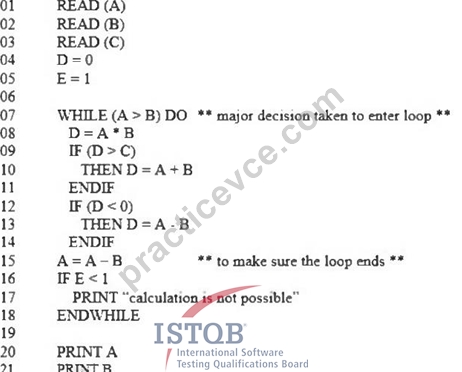
Which type of defect should you report as part of the code review?
- A. Too many nested levels
- B. Unreachable code
- C. No defects should be reported, code is correct.
- D. Endless loop
Answer: D
Explanation:
The code provided contains a potential endless loop. The loop is conditioned on the variable 'E' being less than 1 (IF E < 1), but within the loop, there is no operation that modifies the value of 'E'. Therefore, once the loop is entered, if the condition A > B holds true, the value of 'E' remains unchanged, leading to an endless loop situation. The decrement of 'A' in line 15 does not guarantee an exit condition for the loop, as it does not affect the value of 'E'. This is a control flow defect that could cause the program to hang or crash.
NEW QUESTION # 25
Subject to testing is a software system (COTS) for Project Administration and Control (PACS). PACS is a multi-project system for controlling the project time, e.g., in terms of scheduling and tracking, and managing the productivity of projects, e.g., in terms of effort and deliverables.
During various interviews with stakeholders the following information was gathered:
* Using PACS is not business critical. There is no impact such as high financial losses or problems to the operational continuity of an organization. Its application is not critical since the software package does not support directly the operational, or the primary, business processes of an organization. It supports (project) management in the project planning and tracking process. Of course, it will be highly annoying for users if the system "goes down" from time to time. Although this does not have a high impact for the business process as a whole, the Mean Time Between Failures (MTBF) still needs to be at a good level to be successful in the market.
* Users of PACS typically have an academic educational level, but have no prior experience with this particular type of project management software. The system will be used by a large number of users within an organization.
* The system will be used on a regular basis, e.g., several times per day by project managers and several times per week by project employees. This means that the system will not be used very intensively, often only for some data input or an information request. Its usage is not considered to be very time-critical.
* The data is recorded on-line and real-time. The system is expected to run in multiple hardware environments in various network environments. It is also expected that changes in the operational environments will happen in the upcoming period that also need to be supported.
Based on the information provided by the stakeholder, which combination of non-functional quality characteristics should you propose to test as part of your test approach?
- A. Reliability and Portability
- B. Reliability and Performance efficiency
- C. Performance efficiency and Portability
- D. Security and Reliability
Answer: A
Explanation:
Given the stakeholder information provided:
Reliability is important because the system, while not business-critical, still needs a good MTBF to be successful in the market. This is directly mentioned in the stakeholder information.
Portability is essential as the system is expected to run in multiple hardware environments and various network environments, with changes anticipated in the operational environments.
Security is not highlighted as a concern, and performance efficiency, while generally important, is less critical as the system is not used intensively and is not time-critical. Therefore, reliability and portability are the most relevant non-functional quality characteristics to test in this scenario.
NEW QUESTION # 26
Which of the following statements best captures the difference between data-driven and keyword-driven test automation?
- A. Data-driven test automation is more maintainable than keyword-driven test automation.
- B. Keyword-driven test automation extends data-driven automation by defining keywords corresponding to business processes.
- C. Data-driven test automation extends keyword-driven automation by defining data corresponding to business processes.
- D. Keyword-driven test automation is easier to develop than data-driven test automation.
Answer: B
Explanation:
Keyword-driven test automation is a framework where test cases are written using keywords that represent the actions or tests to be performed on the system. This is an extension of data-driven test automation, which focuses on separating test scripts from the test data, allowing the same test script to be run with various sets of data. Keyword-driven test automation further abstracts the process by allowing tests to be written in a more human-readable form that corresponds to business processes. This approach can improve maintainability and readability of test cases, making them easier to understand and modify. It's not necessarily the case that one is more maintainable or easier to develop than the other (Options C and D); rather, they serve different purposes in test automation strategy.
NEW QUESTION # 27
You are involved in testing a system in the medical domain. Testing needs to comply with the FDA requirements and is rated as being safety critical. A product risk assessment has been performed and various mitigation actions have been identified. Reliability testing is one of the test types that needs to be performed throughout the development lifecycle.
Based on the information provided, which of the following activities would need to be addressed in the test plan?
- A. Design and execution of specific tests that evaluate the software's tolerance to faults in terms of handling unexpected input values.
- B. Design and execution of test cases for scalability.
- C. Testing whether the installation/de-installation can be completed.
- D. Perform a vulnerability scan.
Answer: A
Explanation:
In the context of safety-critical systems, particularly in the medical domain, reliability is of utmost importance. For such systems, it is crucial to ensure that the software can handle unexpected input values and continue to operate without failure. This is essential to ensure patient safety and compliance with FDA requirements. Vulnerability scans (option A) are more related to security testing, whereas scalability (option C) and installation/de-installation (option D) are important but not specifically related to the reliability and safety criticality of the system in the medical domain.
NEW QUESTION # 28
Consider the pseudo code for the Price program: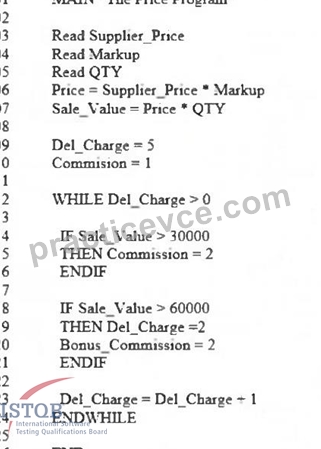
Which of the following statements about the Price program describes a control flow anomaly to be found in the program?
- A. The Price program contains an infinite loop.
- B. The Price program contains unreachable code.
- C. The Price program contains data flow defects.
- D. The Price program contains no control flow anomalies.
Answer: A
Explanation:
The pseudo code provided for the Price program shows a potential for an infinite loop due to the way the 'Del_Charge' variable is being manipulated. The loop is set to continue 'WHILE Del_Charge > 0', and within the loop, 'Del_Charge' is initially set to 5 and then potentially decreased by 2 if 'Sale_Value > 60000'. However, at the end of each loop iteration, 'Del_Charge' is increased by 1. This means that if 'Sale_Value' is not greater than 60000, 'Del_Charge' will not decrease and will instead increment indefinitely, causing an infinite loop. Even if 'Sale_Value' is greater than 60000, the decrement by 2 could be negated by the subsequent increments if the loop runs enough times, potentially leading to an infinite loop situation. There is no guaranteed exit condition once the loop is entered, which is a control flow anomaly.
NEW QUESTION # 29
Within an embedded software project, the maintainability of the software is considered to be critical. It has been decided to use static analysis on each delivered software component.
Which of the following metrics is NOT a maintainability metric typically used with static analysis?
- A. Mean Time Between Failures
- B. Comment Frequency
- C. Number of Lines of Code (LOG)
- D. Number of Function Calls
Answer: A
NEW QUESTION # 30
Which of the following statements is TRUE regarding tools that support component testing and the build process?
- A. Build automations tools facilitate manual testing at a low level by allowing the change of variables values during test execution.
- B. Component testing tools are typically specific to the programming language and may be used to automate unit testing.
- C. Component testing tools are the basis for a continuous integration environment.
- D. Component testing and build automation tools are only used by developers.
Answer: B
Explanation:
Component testing tools, which are often specific to a programming language, are used to automate unit tests (answer C). These tools help to validate the functionality of individual components or units of code in isolation from the rest of the application. While build automation tools are indeed used by developers and are related to continuous integration (answers A and D), and they can facilitate testing at various levels (answer B), component testing tools' primary purpose is to support the testing of individual components, often through automated unit tests, which can be specific to the language in which the components are written.
NEW QUESTION # 31
Within the world of consumer electronics, the amount of embedded software is growing rapidly. The amount of software in high-end television sets has increased by a factor of about eight over the last six years. In addition, the market of consumer electronics has been faced with a 5 -10% price erosion per year. The price of a product is, among a number of other things, determined by the microcontroller used. Therefore, the use of ROM and RAM remains under high pressure in consumer electronic products, leading to severe restrictions on code size.
Within a new high-end TV project, it has been decided to apply dynamic analysis.
Which of the quality goals listed below is MOST appropriate to the project context?
- A. Improve system performance by providing information on run-time system behaviour.
- B. Analyse system failures which cannot easily be reproduced.
- C. Prevent failures from occurring by detecting wild pointers and loss of system memory.
- D. Evaluate network behaviour.
Answer: A
Explanation:
In the context of consumer electronics, where there is rapid growth in embedded software and pressure to minimize code size due to cost constraints, dynamic analysis can be particularly useful for improving system performance. Dynamic analysis involves examining the system's behavior during execution, which can provide insights into the efficiency of the code at runtime, memory utilization, and processing speed. In a high-end TV project where the use of ROM and RAM is under severe restrictions, dynamic analysis would be most appropriately applied to improve system performance, ensuring that the software runs efficiently within the available hardware resources. This supports the project context by contributing to the optimization of the software to run within the constraints of the microcontroller used, thereby potentially reducing costs.
NEW QUESTION # 32
Within an embedded software project, the maintainability of the software is considered to be critical. It has been decided to use static analysis on each delivered software component.
Which of the following metrics is NOT a maintainability metric typically used with static analysis?
- A. Mean Time Between Failures
- B. Comment Frequency
- C. Number of Lines of Code (LOG)
- D. Number of Function Calls
Answer: A
Explanation:
Maintainability metrics typically used with static analysis include measures that reflect the complexity and understandability of the code, such as Number of Lines of Code (LOC), Number of Function Calls, and Comment Frequency. These metrics help in assessing how easily the software can be understood, modified, and maintained. Mean Time Between Failures (MTBF), on the other hand, is a reliability metric. It measures the time elapsed between inherent failures of a system during operation. MTBF is used to predict the system's reliability and is not directly related to the maintainability of the code. Reliability metrics like MTBF would be used in the testing phase to measure the operational reliability of the system rather than during static analysis for maintainability assessment.
NEW QUESTION # 33
A component has been analysed during a risk-assessment and rated as highly critical. Which of the following white-box test techniques provides the highest level of coverage and could therefore be used to test this component?
- A. Statement testing
- B. Decision testing
- C. Multiple condition testing
- D. Modified condition/decision testing
Answer: D
Explanation:
Modified condition/decision testing (MC/DC) provides a higher level of coverage compared to other white-box testing techniques because it requires each condition in a decision to be shown to independently affect that decision's outcome. It is more rigorous than both decision testing (which only requires each decision's possible outcomes to be tested) and statement testing (which requires only each executable statement to be executed). Therefore, for a highly critical component, MC/DC is more appropriate as it ensures a more thorough assessment of the logic in the software component.
NEW QUESTION # 34
Consider the following specification: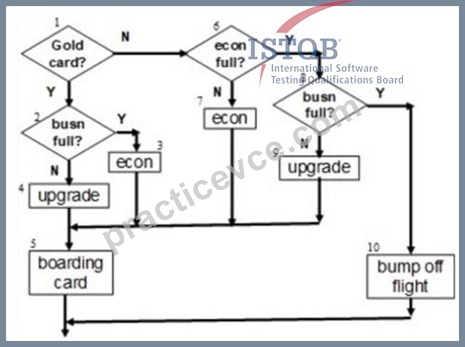
If you are flying with an economy ticket, there is a possibility that you may get upgraded to business class, especially if you hold a gold card in the airline's frequent flier program. If you don't hold a gold card, there is a possibility that you will get 'bumped' off the flight if it is full when you check in late.
This is shown in the control flow graph below. Note that each box (i.e., statement, decision) has been numbered.
Three tests have been run:
Test 1: Gold card holder who gets upgraded to business class
Test 2: Non-gold card holder who stays in economy
Test 3: A person who is bumped from the flight
What is the level of decision coverage achieved by these three tests?
- A. 60%
- B. 75%
- C. 67%
- D. 80%
Answer: C
Explanation:
The control flow graph provided illustrates the decision points for an airline's upgrade and boarding process. Decision coverage is a measure of the percentage of decision points executed during testing:
Test 1 covers the decision points: Gold card? (Yes) and Business full? (No).
Test 2 covers: Gold card? (No) and Economy full? (No).
Test 3 covers the decision that leads to being bumped from the flight, which is Economy full? (Yes) and Business full? (Yes).
From the given tests, the decision points for Gold card? (No) and Business full? (No) are not tested, leaving us with 4 out of 6 decision points covered, which is approximately 67% decision coverage.
NEW QUESTION # 35
Consider the pseudo code provided below:
Which of the following options provides a set of test cases that achieves 100% decision coverage for this code fragment, with the minimum number of test cases?
Assume that in the options, each of the three numbers in parenthesis represent the inputs for a test case, where the first number represents variable "a", the second number represents variable "b", and the third number represents variable "c".
- A. (4,5. 0); {5, 4, 5)
- B. (5. 4, 0); (3, 2, 5); (4, 5, 0)
- C. (5. 3,2)
- D. (5. 3, 2); (6, 4, 2); (5, 4, 0)
Answer: D
Explanation:
To achieve 100% decision coverage with the minimum number of test cases, we need to ensure that every branch of the decision is taken at least once. For the code provided:
The first condition (a>b) is true for the first two test cases and false for the third.
The second condition (b>c) is true for the first test case, false for the second, and does not matter for the third since the first condition is false.
Therefore, with these three test cases, we cover all possible outcomes of the decision, ensuring 100% decision coverage.
NEW QUESTION # 36
Which of the following statements BEST describes how tools support model-based testing?
- A. An engine is provided that allows the user to execute the model.
- B. Random sets of threads of execution are generated as test cases.
- C. Finite state machines are used to describe the intended execution-time behavior of a software-controlled system.
- D. Large sets of test cases are generated to provide full code coverage.
Answer: C
Explanation:
Model-based testing tools support the creation and execution of tests based on models of the system under test. Finite state machines (FSMs) are often used in model-based testing to describe the expected behavior of a system during execution. FSMs help in defining the states of the system and the transitions between these states based on events, which can then be used to generate test cases that validate the system's behavior against the model.
NEW QUESTION # 37
There are multiple activities the Technical Test Analyst performs regarding test automation. Which of the following activities is a typical test automation activity that the Technical Test Analyst will perform?
- A. Train the Test Analyst and Business Analyst to use and supply data for the test scripts.
- B. Execute the test cases and analyze any failures that may occur.
- C. Define the business process keywords and related actions.
- D. Decide regarding a test automation project based on a business case.
Answer: B
Explanation:
A Technical Test Analyst is primarily involved in the technical aspects of test preparation and execution. One of their typical activities includes the execution of test cases, particularly those that are automated, and the subsequent analysis of any test failures to identify defects and issues. This activity is more technical than defining business processes or training other analysts, and while making decisions based on a business case may be part of their role, it is not an activity directly related to test automation.
NEW QUESTION # 38
At which test level would reliability testing most likely be performed?
- A. Functional acceptance testing
- B. System testing
- C. Static testing
- D. Component testing
Answer: B
Explanation:
Reliability testing is aimed at verifying the software's ability to function under expected conditions for a specified period of time. It is typically conducted during system testing, where the software is tested in its entirety to ensure that all components work together as expected in an environment that closely simulates the production environment. Reliability testing is not typically associated with static testing, component testing, or functional acceptance testing, as these levels of testing do not address the overall behavior of the system over time.
NEW QUESTION # 39
......
CTAL-TTA Study Guide Cover to Cover as Literally: https://vceplus.practicevce.com/ISTQB/CTAL-TTA-practice-exam-dumps.html