

Obtain the H12-821_V1.0 PDF Dumps Get 100% Outcomes Exam Questions For You To Pass
H12-821_V1.0 Exam Dumps Contains FREE Real Quesions from the Actual Exam
Huawei H12-821_V1.0 exam covers a wide range of topics related to data communication, including network design principles, network security, and network troubleshooting. H12-821_V1.0 exam is designed to test the candidate's ability to design, implement, and troubleshoot data communication networks using Huawei technologies. certification exam is suitable for professionals who work with large-scale data communication networks and want to enhance their knowledge and skills in core data communication technologies. Passing the Huawei H12-821_V1.0 exam can open up new career opportunities and lead to higher salaries in the field of data communication.
Huawei H12-821_V1.0 (HCIP-Datacom-Core Technology V1.0) exam is a certification test that focuses on core data communication technologies. It is designed for professionals who want to validate their skills and knowledge in data communication and related technologies. H12-821_V1.0 exam assesses the ability of the candidate to plan, design, deploy, and troubleshoot data communication technologies in various scenarios.
NEW QUESTION # 86
A route-policy can have multiple nodes, and each node can have multiple if-match and apply clauses. Which of the following statements are false?
- A. The operator between nodes is OR.
- B. The operator between if-match clauses under a node is OR.
- C. The operator between if-match clauses under a node is AND.
- D. The operator between nodes is AND.
Answer: B,D
Explanation:
The operator between if-match clauses under a node is AND, meaning all conditions must be satisfied.
However, the operator between nodes is OR, meaning a route matching any node will pass the route-policy .
NEW QUESTION # 87
Which of the following statements regarding the BGP error display of a router false?
- A. Error Type indicates that the BGP error is caused by the neighbor relationship error.
- B. The neighbor address of this router is 10.1.1.5.
- C. The error may be caused by the incorrect neighbor address.
- D. The error occurred at 12:40:39 on March 22, 2010.
Answer: A
NEW QUESTION # 88
IGMPV3 not only supports IGMPv1 General Query and IGMPv2 Group-Specific Query, and also IGMPv3 Source/Group-Specific Query.
- A. TRUE
- B. FALSE
Answer: A
Explanation:
IGMPv3 builds on IGMPv1 and IGMPv2 by supporting all previous query types, including General Query and Group-Specific Query, while introducing Source/Group-Specific Query. This enhancement allows finer control over multicast group membership .
NEW QUESTION # 89
On an IS-IS network, each router can generate LSPs. Which of the following events trigger the generation of a new LSP?
- A. Periodic updates occur.
- B. Inter-area IP routes change.
- C. The IS-IS interface cost is increased.
- D. Related IS-IS interfaces go up or down.
Answer: A,C,D
Explanation:
LSP Generation in IS-ISIS-IS routers generate new Link State Packets (LSPs) under the following conditions:
* Interface Status Changes: When IS-IS interfaces go up or down, the link state changes, triggering LSP updates.
* Periodic Updates: IS-IS periodically regenerates LSPs to ensure link-state information remains synchronized across the network.
* Interface Metric Changes: Any modification to interface costs results in a new LSP to reflect the updated cost in the network.
Incorrect Option
* C. Inter-area IP routes change is incorrect because IS-IS does not inherently differentiate between areas for LSP generation.
HCIP-Datacom-Core Reference
* IS-IS LSP generation rules are detailed in the IS-IS configuration and implementation chapters.
NEW QUESTION # 90
ACLs are a common tool for matching routes. ACLs are classified into multiple types based on ACL rule functions. An ACL can be identified by a number, and the number range for each type of ACLs is different.
Which of the following type of ACLs are numbered from 4000 to 4999?
- A. Basic ACL
- B. User-defined ACL
- C. Advance ACL
- D. Layer 2 ACL
Answer: B
Explanation:
ACL Number Ranges
* Basic ACLs: Numbered from 2000 to 2999.
* Advanced ACLs: Numbered from 3000 to 3999.
* Layer 2 ACLs: Numbered from 5000 to 5999.
* User-defined ACLs: Numbered from 4000 to 4999.
HCIP-Datacom-Core Reference
* ACL classifications and their number ranges are covered in the ACL principles and configuration chapters.
NEW QUESTION # 91
Four routers run ISIS and have established adjacencies. The area IDs and router levels are marked in the following figure. If route leaking is configured on R3, which of the following is the cost of the route from R4 to 10.0.2.2/32?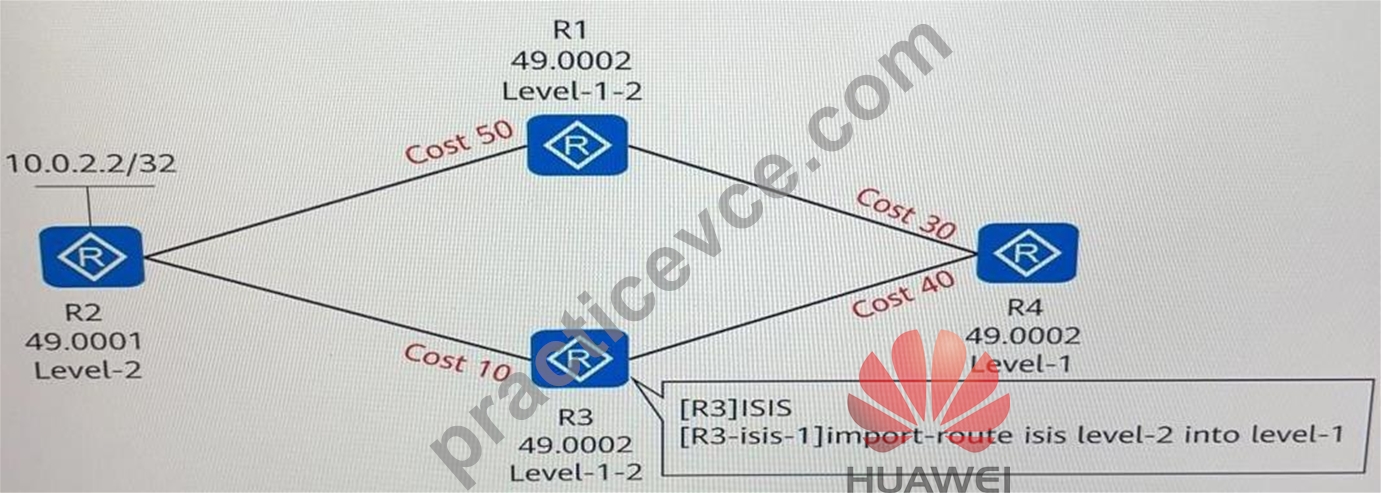
- A. 0
- B. 1
- C. 2
- D. 3
Answer: B
NEW QUESTION # 92
In the OSPF protocol, intra-area route calculation involves only Router LSA, Network LSA, and Summary LSA.
- A. TRUE
- B. FALSE
Answer: B
Explanation:
Intra-area route calculation in OSPF involves only Router LSAs (Type 1) and Network LSAs (Type 2).
Summary LSAs (Type 3) are used for inter-area routes and do not participate in intra-area route calculation.
Therefore, the statement is false .
NEW QUESTION # 93
See the following figure. All routers on the network run IS-IS and are in area 49.0001. By referring to the LSDB of R1, the Level-2 DIS is. (Enter the device name, for example, R1.)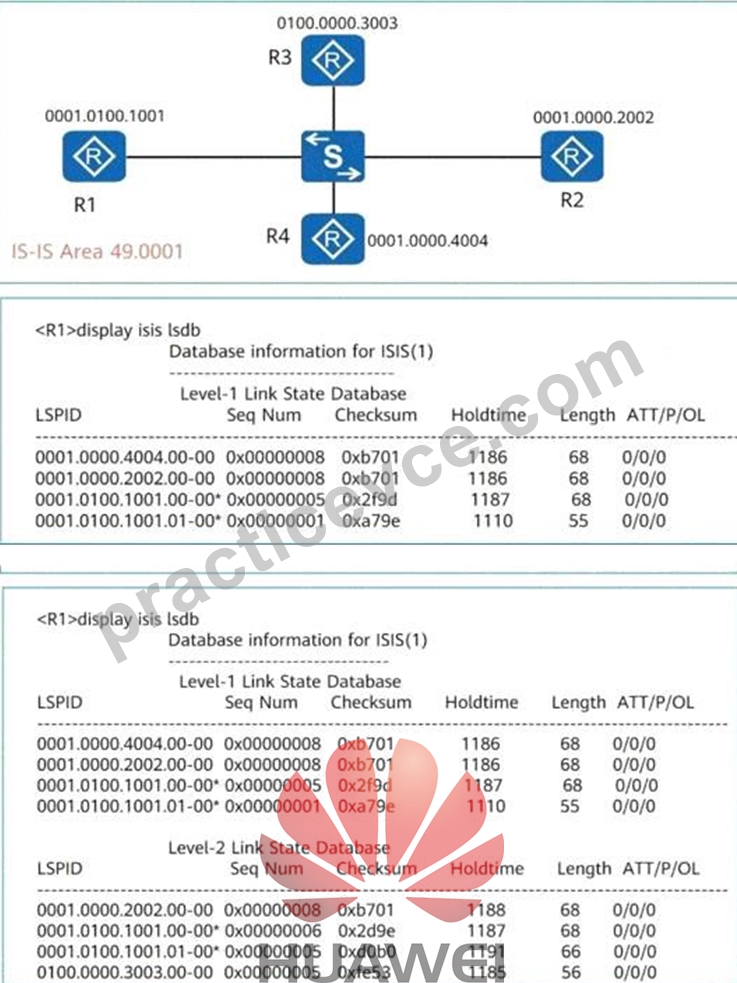
Answer:
Explanation:
R3
* Understanding the LSDB and Level-2 DIS Election in IS-IS:
* In IS-IS, the Designated Intermediate System (DIS) is elected for both Level-1 and Level-2 on broadcast networks to manage the link-state database (LSDB) and reduce the number of LSAs exchanged.
* The election of the DIS is based on the highest priority. If the priority is the same, the router with the highest System ID becomes the DIS.
NEW QUESTION # 94
In an IPv4 address space, Class D addresses are used for multicast. Among Class D addresses, which of the following is the permanent group address range reserved for routing protocols?
- A. 224.0.0.0 to 224.0.0.255
- B. 224.0.1.0 to 231.255.255.255
- C. 232.0.0.0 to 232.255.255.255
- D. 239.0.0.0 to 239.255.255.255
Answer: A
Explanation:
Permanent Group Addresses for Routing Protocols
* The range 224.0.0.0 to 224.0.0.255 is reserved for local network protocols, including routing protocols.
Examples include OSPF (224.0.0.5/6) and RIP (224.0.0.9).
HCIP-Datacom-Core Reference
* Reserved multicast address ranges are detailed in the multicast configuration sections.
NEW QUESTION # 95
In BGP, Notification messages are used to request peers to resend routing information after routing policies are changed.
- A. TRUE
- B. FALSE
Answer: B
Explanation:
Notification Message Purpose
* BGP Notification messages are used to report errors or terminate a connection. They do not request peers to resend routing information after routing policies are changed.
* Routing updates following policy changes require manual resynchronization, not Notification messages.
HCIP-Datacom-Core Reference
* The purpose and usage of Notification messages are discussed in the BGP operation chapters.
NEW QUESTION # 96
After which of the following parameters are modified does an IS-IS neighbor relationship need to re-established?
- A. The interval at which an IS-IS interface sends IIH packets is changed.
- B. The level of an ISIS interface is changed.
- C. The IP address of an ISIS interface is changed.
- D. The cost of an IS-IS interface is changed.
Answer: B
NEW QUESTION # 97
Which of the following statements regarding OSPF route summarization is false?
- A. OSPF supports two route summarization modes: ABR summarization and ASBR summarization.
- B. Any router in OSPF can summarize routes.
- C. Route summarization is the process of summarizing routes with the same prefix into one route and then advertising only the summarized route to other areas.
- D. Route summarization can reduce routing information, decrease the routing table size, and improve router performance.
Answer: D
NEW QUESTION # 98
The Next_Hop attribute in BGP records the next hop of a route. Similar to the next hop in an IGP, the Next_Hop attribute in BGP must be the IP address of a peer interface.
- A. TRUE
- B. FALSE
Answer: B
Explanation:
BGP Next_Hop Attribute
* Unlike IGP, the Next_Hop attribute in BGP does not necessarily have to be the IP address of a peer interface. For example, in multi-hop BGP configurations, the Next_Hop can point to a different router or interface within the network.
HCIP-Datacom-Core Reference
* Details of the Next_Hop attribute and its behavior are outlined in BGP path selection principles.
NEW QUESTION # 99
Which of the following LSAs are advertised only within a single area?
- A. AS External LSA
- B. Router LSA
- C. Summary LSA
- D. Network LSA
Answer: B,D
Explanation:
Router LSAs (Type 1) and Network LSAs (Type 2) are advertised only within a single OSPF area, as they describe the topology within the area. In contrast, Summary LSAs (Type 3) and AS External LSAs (Type 5) are used for inter-area and external routing, respectively .
NEW QUESTION # 100
On the network shown in the following figure, the management VLAN is VLAN 10, and the AP is configured to obtain an IP address on the network segment 10.1.1.0/24 through DHCP. The AP, AC, and AR function as the DHCP client, DHCP relay agent, and DHCP server, respectively. Which of the following configurations for the DHCP relay agent and DHCP server are correct?
- A. [AC] dhcp server group AP
[AC-dhcp-server-group-AP] dhcp-server 172.21.1.2
[AC-dhcp-server-group-AP] quit
[AC] interface Vlanif 10
[AC-Vlanif 10] dhcp select relay
[AC-Vlanif 10] dhcp relay server-select AP
[AC-Vlanif 10] quit - B. [AR] ip pool AP
[AR-ip-pool-AP] network 10.1.1.0 mask 24
[AR-ip-pool-AP] gateway-list 10.1.1.2
[AR-ip-pool-AP] excluded-ip-address 10.1.1.1
[AR-ip-pool-AP] quit
[AR] interface GigabitEthernet 0/0/1
[AR-GigabitEthernetO/O/1] dhcp select global
[AR-GigabitEthernet0/0/l] quit
[AR] ip route-static 10.1.1.0 255.255.255.0 172.21.1.1 - C. [AR] ip pool AP
[AR-ip-pool-AP] network 172.21.1.0 mask 24
[AR-ip-pool-AP] gateway-list 172.21.1.2
[AR-ip-pool-AP] excluded-ip-address 172.21.1.1
[AR-ip-pool-AP] quit
[AR] interface GigabitEthernet 0/0/1
[AR-GigabitEthernetO/0/1] dhcp select global
[AR-GigabitEthernetO/0/1] quit
[AR] ip route-static 10.1.1.0 255.255.255.0 172.21.1.1 - D. [AC] dhcp server group AP
[AC-dhcp-server-group-AP] dhcp-server 10.1.1.2
[AC-dhcp-server-group-AP] quit
[AC] interface Vlanif 10
[AC-Vlanif 10] dhcp select relay
[AC-Vlanif 10] dhcp relay server-select AP
[AC-VlaniflO] quit
Answer: A,B
Explanation:
Option A correctly configures the DHCP relay agent (AC) to forward requests to the DHCP server using VLAN 10.Option B correctly configures the DHCP server (AR) with the correct IP pool (10.1.1.0/24), gateway, and excluded IP addresses. The static route to 10.1.1.0 through 172.21.1.1 ensures proper routing .
=========
NEW QUESTION # 101
Which of the following attacks is not the network layer attack?
- A. IP spoofing attack
- B. ICMP attack
- C. ARP spoofing attack
- D. Smurf attack
Answer: C
NEW QUESTION # 102
......
Huawei H12-821_V1.0 exam is an important certification for IT professionals who want to advance their careers in the field of data communication. It is recognized globally and is highly valued by employers. Passing H12-821_V1.0 exam demonstrates a high level of expertise in data communication core technology and can lead to better job opportunities and higher salaries.
Use Real Huawei Achieve the H12-821_V1.0 Dumps - 100% Exam Passing Guarantee: https://vceplus.practicevce.com/Huawei/H12-821_V1.0-practice-exam-dumps.html