

Pass 700-905 Exam in First Attempt Guaranteed 100% Cover Real Exam Questions [Dec-2021]
Valid 700-905 test answers & Cisco 700-905 exam pdf
NEW QUESTION 27
Where is the VIC configuration for number type, identify, failover, settings, and bandwidth stored?
- A. in non-volatile memory on the VIC
- B. in UCS Manager server profiles
- C. in VCenter virtual machine image
- D. in UCS Manager service profiles
Answer: A
NEW QUESTION 28
Which two results are expected when you replace a node or expand a cluster? (Choose two.)
- A. Distributed pooled data is migrated off nodes to master data store.
- B. Affected node is marked as unhealthy and placed into standby mode
- C. On node replace, the self-healing must finish for the cluster to be healthy
- D. vSphere DRS migrates the virtual machines to the new node to balance the load
- E. The cluster profile is updated and RAID takes care of rebalancing the load.
Answer: C,D
Explanation:
NEW QUESTION 29
HyperFlex uses file system native snapshots and provides which three features? (Choose three.)
- A. on datastore level, snapshots work the same as vSphere snapshots
- B. automatic update to the golden image when a configuration change is made
- C. impact on the VM performance after a lot of writes, requiring future administration
- D. consolidation of snapshots is still manual but not necessary
- E. automatically deduplicating data of snapshots through StorFS
- F. limitations in age and number of snapshots. See user manual for limitations
Answer: A,E,F
NEW QUESTION 30
Which three configurations for read caching in Cisco HyperFlex are valid? (Choose three.)
- A. Write-first (default for VDI): Infrequently used data is cached: freeing system resources for VDI
performance - B. No caching (SSD): With all-flash nodes; because there is little difference in read speeds between SSDs
- C. Battery-Initiated Read-back (default): Only read data and most commonly used data are deposited in the
Level 4 read-back cache - D. Write-back (default): Only write information and most commonly used information are deposited in the
cache - E. Write-through (install option for VDI): Only most commonly used data is cached: optimizing VDI
performance - F. Level 4 cached (SSD): With semi-flash nodes; there is a large difference in read speeds between SSDs
Answer: B,C,F
NEW QUESTION 31
Which three additional management tools are included in HXDP to configure HyperFlex clusters? (Choose
three.)
- A. Cisco IMC 13
- B. Data Center Network Manager
- C. HyperFlex Connect
- D. Storage CLI
- E. REST API
- F. UCS Manager
Answer: C,D,E
NEW QUESTION 32
HyperFlex virtual servers differ from regular servers in which two key areas? (Choose two.)
- A. CVM: Virtual appliance, which performs reading/writing, caching, deduplication, and compression.
- B. NVMe: Regular servers do not support NVMe drives for high availability.
- C. SP: UCS Service Profiles are used to delineate MAC address pools from upstream networks.
- D. CCC: Cisco Cloud Center is used for multi-cloud integration and seamless deployment.
- E. No RAID is required to consolidate disks into a shared data platform.
Answer: A,E
Explanation:
NEW QUESTION 33
Which three advantages of using the M5 generation of HyperFlex servers over the M4 generation are valid?
(Choose three )
- A. Microsoft Hyper-V support
- B. NVMe support
- C. M.2 SATA drive support for faster disk I/O
- D. DDR3 memory
- E. Support for Cisco VICs
- F. Multiple GPUs
Answer: B,C,F
NEW QUESTION 34
What is the maximum size of an HXDP cluster running 3.5.1?
- A. 8 nodes
- B. 32 nodes
- C. 64 nodes
- D. 16 nodes
Answer: C
Explanation:
NEW QUESTION 35
Which two ways does Cisco HyperFlex upgrade the traditional RAID? (Choose two.)
- A. Hardware replacement initiates self-healing with minimal impact
- B. Eliminating the need for additional hardware cards, while maintaining high performance.
- C. HyperFlex enables stretched RAID arrays spanning multiple geographic sites.
- D. Limiting the number of drives locally, which are not a part of the shared datastore.
- E. Distributing data locally, not just across the hosts in HyperFlex cluster
Answer: A,B
Explanation:
NEW QUESTION 36
Drag and Drop Question
Drag the server type from the left onto the maximum number of capacity drives on the right.
Answer:
Explanation:
Explanation:
NEW QUESTION 37
HyperFlex compute nodes contribute what percentage of the overall disk storage capacity?
- A. 20%
- B. 10%
- C. 5%
- D. 0%
Answer: B
NEW QUESTION 38
Which two processes does Disk Failure initiate? (Choose two)
- A. Distributed pooled data is migrated off nodes to master data store.
- B. Self-healing mode is initiated and data replication factors applied.
- C. The affected cluster is marked as unhealthy and placed into standby mode
- D. If the replication factor is sufficient for the failure, the system is marked as unhealthy but remains operational
- E. Performance is almost unaffected Sets 1-minute timer until self-healing starts.
Answer: D,E
Explanation:
NEW QUESTION 39
Which two features enable RAID cards striping as well as mirroring and parity1? (Choose two.)
- A. No load on the system resources, drives seem as one drive to the operating system
- B. Distributed drives across disparate systems can be in RAID together.
- C. On RAID card failure, the RAID onboard concurrent cache assists rebuild cache.
- D. Hot replacement of drives available, depending on configuration
- E. Integration with Cisco Intersight for a cloud-based storage management solution.
Answer: B,C
NEW QUESTION 40
Cisco HyperFlex AII-NVMe nodes are expected to be supported beginning in which HXDP version'?
- A. HXDP 4.0
- B. HXDP 3 5.2
- C. HXDP 4.0.1
- D. HXDP 3.5.1
Answer: A
Explanation:
NEW QUESTION 41
HyperFlex virtual servers differ from regular servers in which two key areas? (Choose two.)
- A. CVM: Virtual appliance, which performs reading/writing, caching, deduplication, and compression.
- B. NVMe: Regular servers do not support NVMe drives for high availability.
- C. SP: UCS Service Profiles are used to delineate MAC address pools from upstream networks.
- D. CCC: Cisco Cloud Center is used for multi-cloud integration and seamless deployment.
- E. No RAID is required to consolidate disks into a shared data platform.
Answer: A,E
NEW QUESTION 42
Which three features for NVMe transfer protocol are valid? (Choose three.)
- A. Requires 10 controller
- B. Uses PCIe interface
- C. Improves SAS and SATA speed
- D. Streamlined commands for fewer CPU instructions
- E. More and deeper queues
- F. Increases memory speed for more lOPs
Answer: B,D,E
NEW QUESTION 43
There are often disadvantages when using mixed hardware, and uniform systems are highly advised. What are three disadvantages of using validated yet mixed hardware? (Choose three.)
- A. "Hardware only" solutions require less latency for data aggregation.
- B. Validated yet "mixed" hardware systems may be supported by the specific original equipment manufacturers but software vendors require a master level services agreement.
- C. "Software only" solutions can result in a lack of simplicity for installation and maintenance. While setup and maintenance of an HCI solution might be simple you still need to configure and maintain the hardware part, which is not orchestrated by the HCI solution.
- D. "Software only" HCI solutions often mean that HCI vendors do not have control over the hardware that the consumer is using. The lack of control over the hardware can result in hardware not being security-compliant (usually the case with white box solutions) or not being optimally configured for the given HCI solution.
- E. "Software only" solutions are inherently more secure, adhering to government regulations.
- F. Validated hardware does not mean smooth performance, which particularly applies to hardware that is seldom chosen for the hardware part of the "software only" solution.
Answer: C,D,F
Explanation: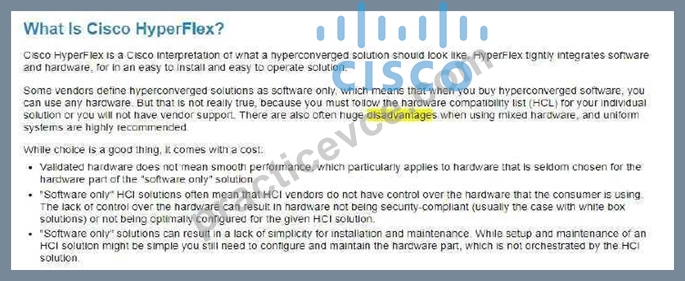
NEW QUESTION 44
In all HX server types, where are capacity drives installed?
- A. side
- B. top
- C. back
- D. front
Answer: D
Explanation:
NEW QUESTION 45
Where is the VIC configuration for number type, identify, failover, settings, and bandwidth stored?
- A. in VCenter virtual machine image
- B. in UCS Manager service profiles
- C. in UCS Manager server profiles
- D. in non-volatile memory on the VIC
Answer: C
NEW QUESTION 46
What is required to cluster a pair of Fabric Interconnects?
- A. uplink connections to the enterprise network
- B. HXDP 3.5.2 or better
- C. UCS Manager 2.1 or better
- D. connection between the Fl pair using ports L1 and L2
Answer: D
NEW QUESTION 47
Which two statements on Replication Factors are valid? (Choose two.)
- A. When performing rolling upgrades, the upgraded node is down for maintenance, stretching RF2 to the absolute limit.
- B. LAZ can increase RTO for 16+ node clusters.
- C. RF3 has 100% better protection of data while using 33% more space and is recommended.
- D. RF2 has 100% better protection of data while using 33% more space and is recommended.
- E. LAZ can decrease fault tolerance of S+ node clusters to less than 4
Answer: A,C
Explanation:
NEW QUESTION 48
Which two components are automatically configured from the information provided to the HyperFlex installer? (Choose two )
- A. server firmware policy
- B. the network
- C. controller VM configuration
- D. operating system deployment preparation
- E. application dependencies
Answer: B,C
NEW QUESTION 49
When local writing or reading is performed, the lOVisor intercepts the read/write requests and forwards them
to CVMs across the cluster This action allows non-local CVMs to be aware of the input/output requests so that
they can perform the appropriate input/output action lOVisor provides which two additional functionalities?
(Choose two.)
- A. enables asynchronous replication of data across individual HyperFlex nodes with sub-second
re-convergence - B. when an lOVisor fails, the CVM remains active and functional, which enables uninterrupted operation
of the system by forwarding 10 to another available lOVisor In the HyperFlex cluster - C. provides redundancy when local CVM fails, offloading data processing to another CVM in the cluster
- D. intercepts local virtual machines' reads and writes and distributes them across the network eliminating
hotspots - E. integration point for deployment of cloud-based SaaS offerings from eco-system partners
Answer: A,B
NEW QUESTION 50
Which three additional management tools are included in HXDP to configure HyperFlex clusters?
(Choose three.)
- A. Cisco IMC 13
- B. Data Center Network Manager
- C. HyperFlex Connect
- D. Storage CLI
- E. REST API
- F. UCS Manager
Answer: C,D,E
Explanation:
NEW QUESTION 51
......
700-905 Exam Questions – Valid 700-905 Dumps Pdf: https://vceplus.practicevce.com/Cisco/700-905-practice-exam-dumps.html